
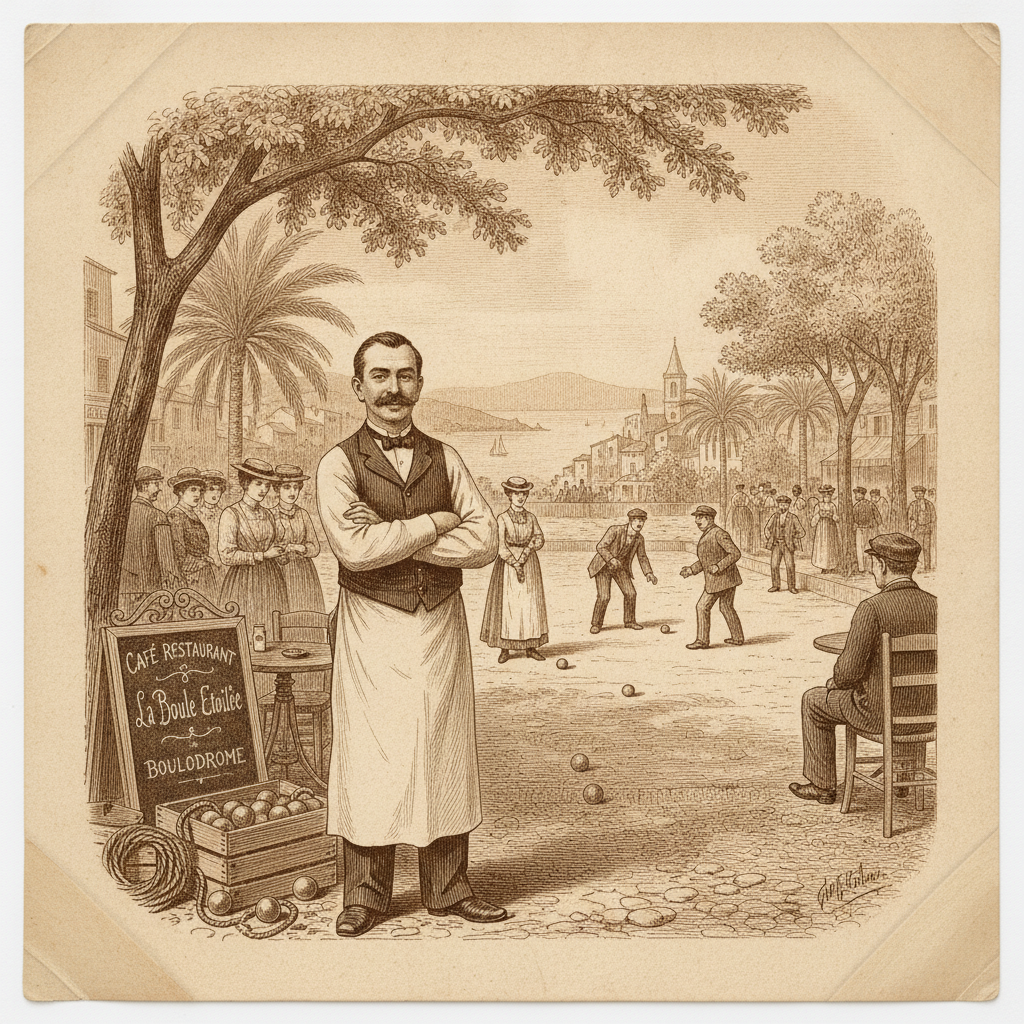
Ernest Pitiot - Founder | Petanque Player Profile
Ernest Pitiot, the La Ciotat boules-ground owner credited with adapting jeu provencal into petanque (dated 1907 by the FFPJP, 1910 by other historians), later founded a regional federation in Herault and served as interim FFPJP president in 1957.
🇫🇷
Nationality
Federation Founder
Role
Career Achievements
The Café Owner Who Rewrote the Rules of Boules
Ernest Pitiot is the man most directly credited with the specific idea that separates pétanque from every other boules game that came before it. Together with his brother Joseph, Pitiot ran a café called the Bar de l'Horloge in the Provençal port town of La Ciotat, and the brothers built an adjoining boules ground - which they named La Boule Étoilée - on the town's Béraud grounds. It was on that boules ground that Pitiot's proposal changed the sport forever.
As with Jules Hugues, the player whose circumstances prompted the idea, very little of Pitiot's early biography survives in the historical record - no source consulted for this profile, including the fullest family-sourced account (a history by Joseph Pitiot's granddaughter Martine Pilate), documents his exact birth year. What is well documented, across the FFPJP's own official history, regional club histories, and Pilate's account, is what he did with the years that followed.
The Idea That Became Pétanque
Hugues, a locally admired jeu provençal champion, had been forced out of the sport by severe rheumatism that made its mandatory three-step running throw impossible for him to perform. Watching a game at the Béraud grounds, Pitiot proposed a fix: rather than the running approach, players would throw from a stationary position, both feet planted together inside a small circle drawn on the ground. The Provençal phrase for that stance, pè tanca ("feet planted"), gave the new game its name - pétanque.
Exactly when this happened is disputed among the sport's own historians. The FFPJP's own official history page dates the pivotal game to 1907, three years ahead of the first official tournament. Pétanque historians Jac Verheul and Martine Pilate instead place it in the spring of 1910, only months before that same tournament. Even Pilate's own family-sourced account hedges between the two years rather than settling on one. This profile follows the FFPJP's 1907 dating for consistency with the federation's own account, but readers should know the two years are both in circulation.
Pitiot did not stop at the idea itself. Over the following years, he and Joseph worked to formalize the new game's rules, and in 1910 they organized La Ciotat's first official tournament under them - the event most historical accounts treat as pétanque's true public debut. For the fuller timeline connecting that tournament to the sport's later international growth, see our complete history of pétanque.
From La Ciotat to Languedoc
Unlike Hugues, whose story is inseparable from La Ciotat itself, Pitiot's involvement with the sport continued for decades afterward. He eventually left the town, relocating to the Hérault département in Languedoc, where records place him holding positions of responsibility at the casino in Palavas-les-Flots and playing regularly on Montpellier's historic Peyrou terrain, close to where he lived on rue de l'Aiguillerie.
According to Martine Pilate's family history, Ernest's next major contribution was sparked by a slight, not a rejection: when he proposed that pétanque teams be allowed to enter a Montpellier jeu provençal tournament alongside the traditional teams, a rival club president mocked the idea, reportedly dismissing pétanque as "a little girl's game." Furious, Pitiot spent that same night drafting rules and statutes for a new federation with his wife's help, and registered it with the Hérault prefecture the next morning. The Fédération du Languedoc-Roussillon de la Piedtanque, one of pétanque's earliest formal regional governing bodies, was established that way in late 1943; its official notice appeared in the Journal Officiel on 25 May 1945, just weeks before the FFPJP's own founding. Pitiot did not lead the federation he founded - his close friend Raoul Meyer became its first president.
Founding the FFPJP
That regional groundwork mattered when the sport organized nationally. When the Fédération Française de Pétanque et Jeu Provençal (FFPJP) was founded in Marseille on 31 July 1945, family-history accounts credit Pitiot's Languedoc-Roussillon federation with helping bring roughly 1,000 licensed players into the new national body - though the surviving record does not make entirely clear whether that figure reflects his federation specifically or the broader national enthusiasm around the FFPJP's founding.
Pitiot's formal leadership of the national federation came over a decade later, and briefly. The FFPJP's own published list of national presidents shows Marcel Pinodel as its first president, serving from 1946 until his death in 1957. Pitiot then served as interim president for about one year in 1957, before Louis Altério took over in 1958 and led the federation for the following decade. Pitiot was not, as a small number of secondary sources have claimed, the FFPJP's founding or longest-serving president - but he was present at the federation's creation as a major founding contributor, and he did briefly lead it at a moment of transition.
A Legacy Measured in Millions of Players
Ernest Pitiot's name is less widely known today than the champions who followed him onto the terrain, but his fingerprints are on nearly every rule that defines the modern game: the fixed circle, the planted feet, the shorter playing distance that made the sport accessible to people of any age or physical condition. What began as a single accommodation for a friend with rheumatism grew, through Pitiot's own decades of organizing work in La Ciotat and then in Languedoc, into the founding structure of French pétanque's national federation - and, by extension, into a sport now played by an estimated 20 million people in more than 100 countries. See our profile of Jules Hugues for the story of the player whose circumstances started it all, and our history of pétanque for the complete timeline from that 1907 afternoon to today's global game.
Frequently Asked Questions
Who was Ernest Pitiot?
Ernest Pitiot was a boules-ground owner in La Ciotat, France, credited with proposing the rule change - throwing from a fixed position with feet planted inside a circle - that turned jeu provençal into pétanque. The FFPJP's own official history dates that pivotal game to 1907; pétanque historians Jac Verheul and Martine Pilate instead place it in 1910. Pitiot went on to organize the sport's first tournament in 1910, found one of the game's earliest regional federations in the 1940s, and briefly serve as interim national president of the FFPJP in 1957.
What exactly did Ernest Pitiot invent?
Pitiot did not invent boules itself - jeu provençal already existed - but he proposed the specific rule adaptation that created pétanque: playing without a running approach, both feet planted together inside a small drawn circle, so that his friend Jules Hugues, whose rheumatism had ended his jeu provençal career, could keep playing. That idea - tried out either in 1907 (per the FFPJP's own official history) or in 1910, only months before the first official tournament (per pétanque historians Jac Verheul and Martine Pilate) - gave the new game both its rules and its name.
Did Ernest Pitiot run the café where petanque was invented?
Not quite. Pitiot and his brother Joseph ran a café called the Bar de l'Horloge in La Ciotat, and separately built a boules ground on the town's Béraud grounds, which they named La Boule Étoilée. It was on that boules ground, not at the café itself, that the pivotal game with Jules Hugues took place and where the first official tournament was organized in 1910.
What did Ernest Pitiot do after La Ciotat?
Pitiot later relocated to the Hérault département in Languedoc, where he held positions at the casino in Palavas-les-Flots and played regularly on Montpellier's Peyrou terrain. According to a family history written by his brother Joseph's granddaughter, Martine Pilate, his next major step came after a rival club president mocked his proposal to let pétanque teams enter a Montpellier tournament alongside traditional jeu provençal teams. Furious, Pitiot spent a single night in 1943 drafting rules and statutes with his wife's help and registered the Fédération du Languedoc-Roussillon de la Piedtanque, one of the sport's first regional governing bodies, with the Hérault prefecture the next morning. He did not lead the federation himself - his close friend Raoul Meyer became its first president.
Was Ernest Pitiot the first president of the FFPJP?
No - that is a common misconception. The FFPJP's own published list of national presidents shows Marcel Pinodel as its first president (1946-1957); Pitiot served only as interim president for about a year in 1957, following Pinodel's death, before Louis Altério took over in 1958. Pitiot's larger contribution was as a founding figure: family-history accounts credit his Languedoc-Roussillon federation with helping bring roughly 1,000 licensed players into the FFPJP when it was founded in Marseille in July 1945, though the surviving record does not make clear whether that figure was specific to his federation or reflected the broader national enthusiasm around the FFPJP's founding.