
Pétanque Scoring Rules Explained: A Complete Guide
Master the art of counting points in pétanque. Learn basic scoring, dead jack rules, measurement etiquette, and the legendary Fanny tradition.
Pétanque Scoring Rules Explained: A Complete Guide
At first glance, scoring in pétanque seems simple: the team that gets closest to the jack wins. However, once you step onto the terrain, questions quickly arise. What happens if the jack is knocked out of bounds? Who is responsible for measuring? And what on earth does "kissing the Fanny" mean?
In this guide, we break down every nuance of pétanque scoring, from basic counting to advanced competitive scenarios.
The Objective
A standard game of pétanque is played to 13 points. While some casual games or timed tournament rounds may use different targets (like 11 points or a fixed time limit), 13 is the universal standard for "winning the game."
How a Round (Mène) Works
Pétanque is played in rounds, called mènes in French. A round ends when both teams have thrown all their boules.
- Winning the Round: Only one team can score points in a single round. The team with the boule closest to the jack is the winner of that round.
- Counting the Points: The winning team receives 1 point for every boule that is closer to the jack than the opponent's best (closest) boule.
Scoring Example
- Team A has boules at 10cm, 25cm, and 40cm from the jack.
- Team B has their closest boule at 30cm from the jack.
- Result: Team A wins the round. They get 2 points because they have two boules (10cm and 25cm) that are closer than Team B's best boule (30cm).
What Happens if the Jack Goes "Dead"?
In pétanque, the jack is considered "dead" (out of play) if it is knocked out of the designated boundary, becomes invisible from the circle, or is moved to an invalid distance (usually less than 3m or more than 20m from the circle).
The scoring for a dead jack depends on how many boules are left in hand:
- Scenario 1: Both teams have boules left: The round is void. No points are awarded, and the round is restarted from the opposite end.
- Scenario 2: Only one team has boules left: This is a major advantage. That team receives 1 point for every boule they have left in their hand.
- Scenario 3: Neither team has boules left: The round is void. No points are awarded.
The Art of Measurement
Measuring is one of the most frequent sources of tension on the terrain. The official FIPJP rules (Articles 25-28) are very specific about how this should be handled.
Who Measures?
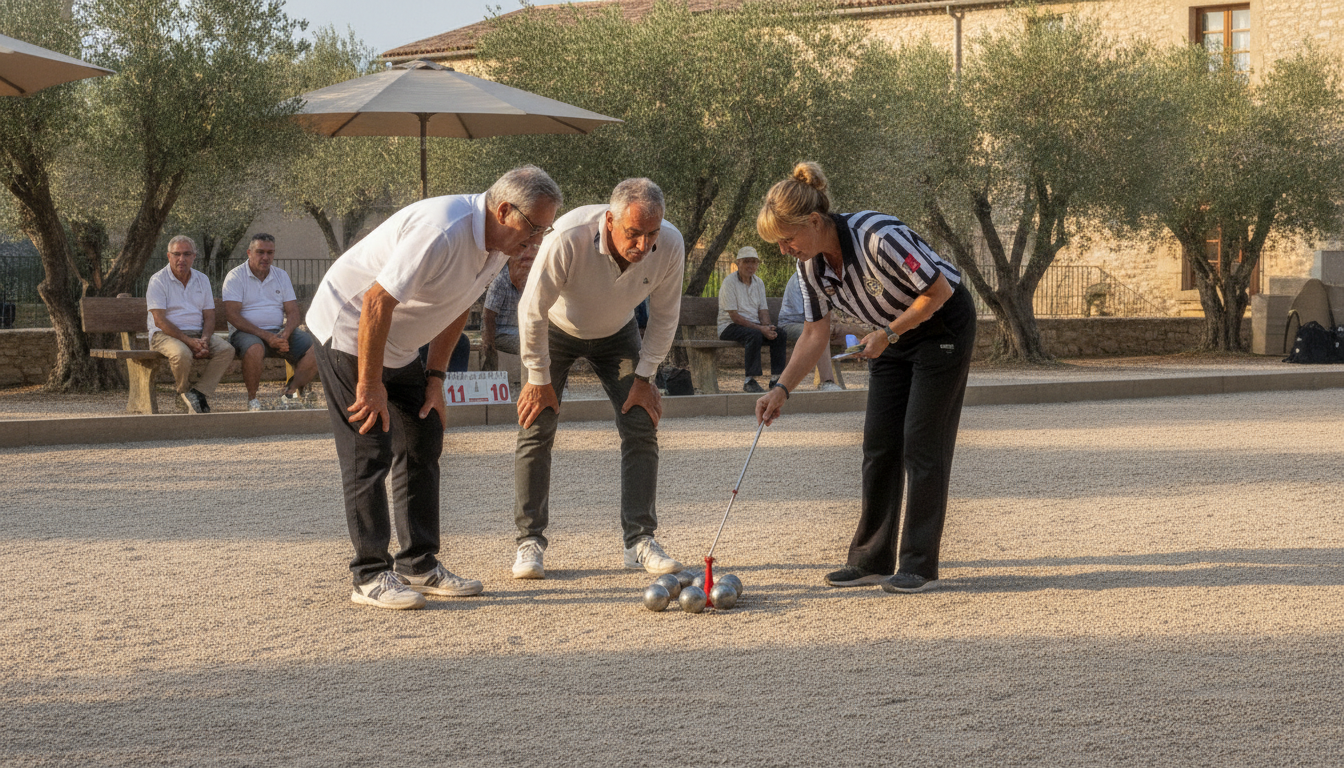
The team that threw the last boule is responsible for measuring. However, the opponents always have the right to measure after them. In competitive matches, if teams cannot agree, an umpire is called, and their decision is final.
Measurement Rules & Etiquette
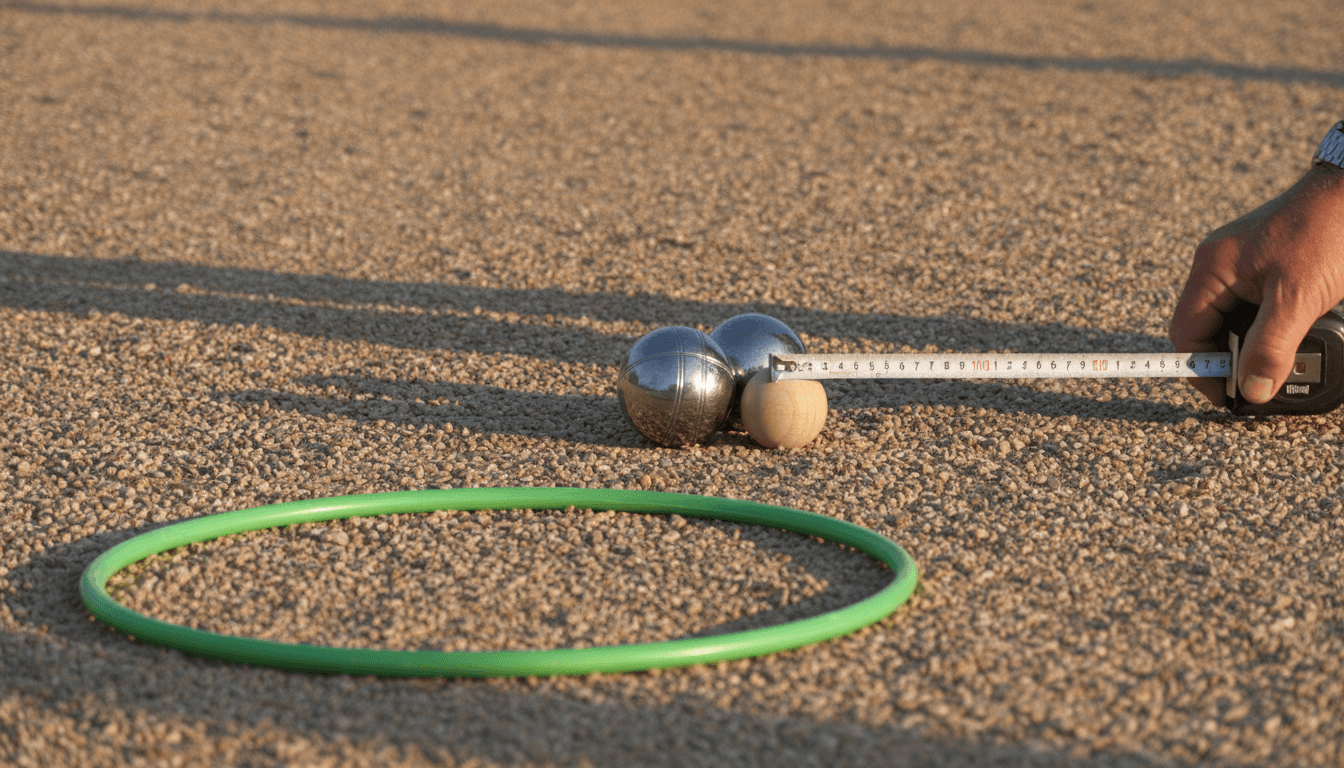
- Tools Only: You must use a proper measuring tool (tape measure, folding ruler, or professional pétanque compass). Using your feet, hands, or twigs to measure is strictly forbidden and can lead to penalties.
- Don't Move the Boules: If you accidentally move the jack or a boule while measuring, the point is usually awarded to the opponent. Always be extremely careful.
- The "Equidistant" Tie: If the closest boules of both teams are exactly the same distance from the jack, the team that threw the last boule plays again. If they still can't break the tie, the other team plays. This continues until the tie is broken or everyone is out of boules. If all boules are played and it's still a tie, the round is void.
The "Fanny" Tradition
In pétanque culture, losing a game 13-0 is a special kind of humiliation known as "Fanny."
Nobody agrees on the true origin - at least half a dozen versions of the legend circulate. The most commonly cited traces back to a café in Grand-Lemps just before World War I, where a waitress named Fanny would let losers who hadn't scored a single point kiss her... though not on the cheek. Today, most pétanque clubs have a statue or painting of a bare-bottomed "Fanny."
If you lose 13-0, you are traditionally expected to:
- Kiss the Fanny: Lean in and kiss the bottom of the statue.
- Buy the Drinks: In modern social play, "Fanny pays for drinks" is the more common (and less embarrassing) rule.
How to Track Your Score
Staying focused on your technique is easier when you aren't trying to remember the score in your head.
1. Manual Scoreboards
Most professional terrains have fixed scoreboards with sliders or pegs. For personal use, many players carry a pocket score counter. These small, mechanical devices allow you to click or dial the score for each team.
2. Digital Apps
Several mobile apps are now popular for score tracking:
- Pétanque Score (iOS/Android): Simple, clean, and easy to use in the sun.
- Tape Measure Apps: Some apps use your phone's camera to measure distances between boules, which is great for settling friendly disputes.
Where to Buy: Measuring Tools & Score Counters
Since feet and boules are banned for measuring, and remembering the score in your head gets harder as the game wears on, a proper tool for each job pays for itself in the first close end.
Professional Pétanque Compass
Most PreciseHigh-precision folding calipers for settling the closest calls on the court. FIPJP-legal and far more accurate than a tape measure for millimeter disputes.
Best Price: €25 - €32 · PetanqueShop
Obut Professional Measuring Tape
Club StandardA rigid 2-meter metal tape with an extendable slide, the standard tool used by clubs and umpires to settle close ends with millimetric accuracy.
Best Price: €11 · PetanqueShop
Obut Pocket Score Keeper
Pocket-SizedA two-wheel pocket counter that tracks 0 to 13 points for both teams, so nobody has to hold the score in their head through a long round.
Best Price: €11.00 · Obut
Summary Checklist for Scoring
- Games are usually played to 13 points.
- Only the team with the closest boule scores.
- You get 1 point for every boule closer than the opponent's best.
- If the jack goes dead and you have boules left but the opponent doesn't, you get points for your remaining boules.
- Always use a proper tool for measuring; never use your feet!
Frequently Asked Questions
What happens if a boule touches the jack?
This is called a "biberon" (baby bottle). It is the best possible position, but the boule can still be knocked away by the opponent.
Can I measure before the end of the round?
Yes! You can measure at any time during the round to determine which team is currently holding the point.
What if we both have boules at the exact same distance?
This is an equidistant tie. The team that played last must play again. If they still don't hold the point, the other team plays, and so on.
Does a game always have to go to 13?
In most competitions, yes. However, some tournaments use a time limit (e.g., 45 minutes + 2 ends), after which the high score wins.
Related Articles
Official Pétanque Rules: The Complete 2026 FIPJP Guide
Master the official pétanque rules as defined by the FIPJP. Learn game formats, valid jack placement, the advantage rule, and tournament regulations.
Pétanque Court Dimensions and Setup Guide
Everything you need to know about official FIPJP pétanque court dimensions, marking rules, surface materials, and terrain setup for competitions and home play.
Pétanque Rules 2026: What Actually Changed (and What's a Rumor)
FIPJP confirms no international rule changes for 2026 - despite social media claims. Here's what France's federation actually updated, and what stayed the same.