
How to Umpire a Pétanque Match: Rules & Duties Guide
What a pétanque umpire does, when to call one, the yellow/orange/red card system, and how to get certified - based on the official FIPJP rules.
How to Umpire a Pétanque Match: Rules & Duties Guide
Most club games of pétanque never see an umpire - players measure their own points and sort out disagreements themselves. Once you step into an organized tournament, though, an umpire's role becomes formal: enforcing the official rules, settling measurements no one can agree on, and keeping play fair when tempers or close calls threaten to derail a game. This guide covers exactly what an umpire does, when players should call one, the card-based penalty system, and how to work toward a real umpiring certification if you want to officiate for your club or federation.
What Does a Pétanque Umpire Actually Do?
Under Article 40 of the official FIPJP rules, umpires are charged with watching for "strict application of the rules of play and the administration rules which complete them." In practice, that authority covers the whole match:
- Confirming boules and jacks meet the approved specifications before play, and re-examining them at any point during the game if a complaint is raised.
- Ruling on jack validity - whether a thrown jack is at a legal distance, or visible from the circle when that's disputed (Article 7 makes this call "without appeal").
- Measuring, or settling a measurement the two teams cannot agree on (Article 26).
- Issuing cards and other penalties for rule violations, unsporting conduct, or bad behavior (Articles 35 and 39).
- Deciding whether bad weather stops play, and whether a stalled competition phase needs to be halted (Articles 36 and 37).
- Referring anything the rulebook doesn't cover to the competition's jury (Article 41).
Subject to the seriousness of the offense, umpires have the authority to exclude a player or team from a game, or disqualify them from the whole competition, if they refuse to comply with a ruling.
When Should You Call an Umpire?
Under the FIPJP rules, an umpire's involvement is triggered by a few specific situations, not a general "referee" watching every throw:
- A measurement dispute. The team that threw the last boule measures first, but the opponents always have the right to measure after them. If the two sides still disagree, either team can call an umpire, whose decision is final. See our scoring guide for the full measuring etiquette.
- A jack validity question. Whether the jack was thrown to a legal distance, or whether it's visible from the circle, can only be ruled on by an umpire once it's disputed (Article 7).
- A suspected illegal boule. Complaints that a boule doesn't meet the diameter, weight, or engraving requirements are admissible before a game starts; complaints that a boule has been tampered with (hollowed and filled, or re-tempered) are admissible at any point but must be raised between ends.
- A rules question neither team can resolve, or any behavior that crosses into poor sportsmanship. Article 31 is explicit: all complaints must be made to an umpire, and none can be accepted once the game's result has been agreed.
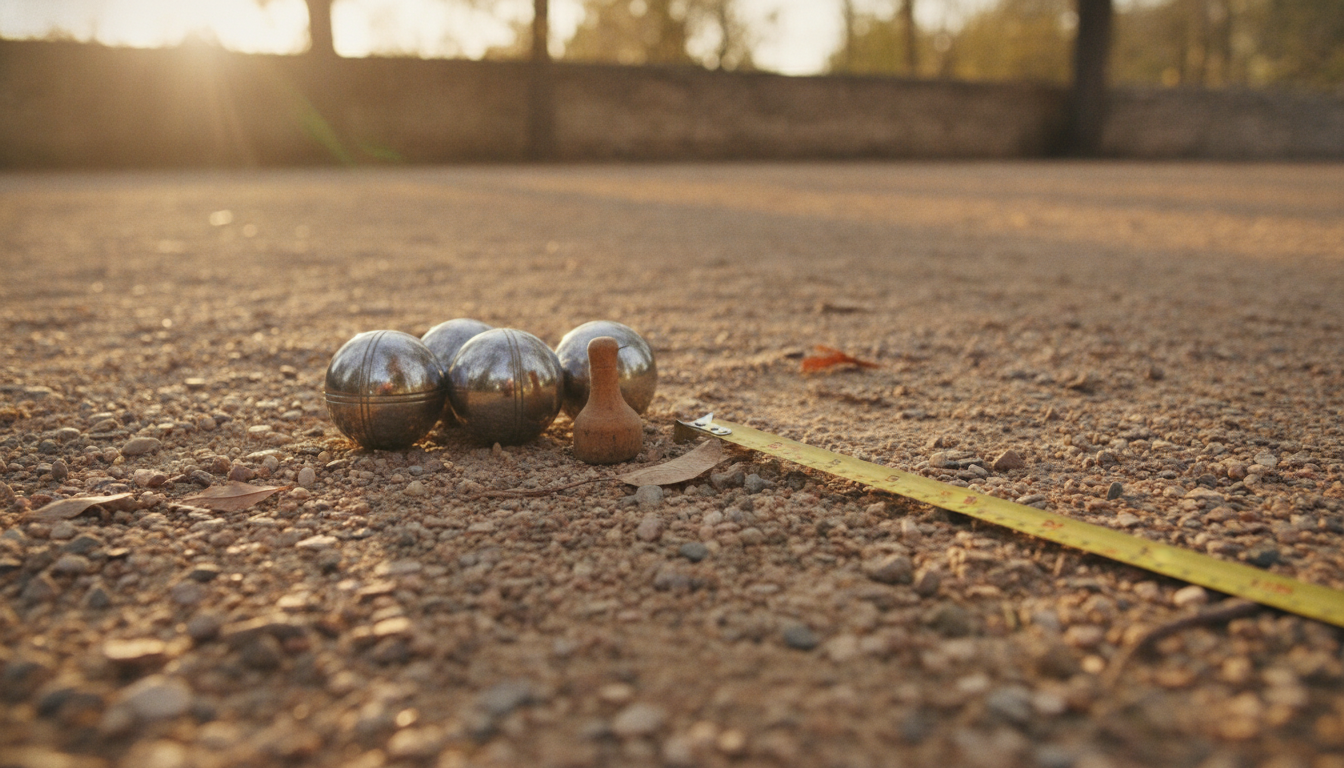
Obut Professional Measuring Tape
Club StandardA rigid 2-meter metal tape with an extendable slide - the standard tool clubs and umpires use to settle close measurements with millimetric accuracy.
Best Price: €11 · PetanqueShop
Pétanque Thickness Gauge Measuring Set (20 blades)
Referee ToolA referee-grade feeler-blade gauge built for the very tight gaps where a tape measure alone can't settle a call.
Best Price: €8.83 · PetanqueShop
The Card System: How Penalties Work
FIPJP Article 35 lays out a graduated, three-card penalty system:
- Yellow card - Warning. An official warning for a rule infraction. One specific case is automatic: exceeding the throwing time limit earns the whole offending team a yellow card, and any player who's already been carded that game is disqualified from the boule they're about to play instead.
- Orange card - Boule disqualified. The boule just played, or about to be played, is removed from the game.
- Red card - Player excluded. The player is excluded from the rest of that game.
Beyond individual cards, an umpire can also disqualify an entire team, or both teams in a case of complicity. A warning can only be given after an actual infringement - simply reminding players of the rules before a match doesn't count as one.
Separately, bad behavior or violence toward an official, umpire, another player, or a spectator (Article 39) escalates further: exclusion from the competition, withdrawal of a player's federation licence, and confiscation of prizes or expenses are all on the table, with the umpire empowered to impose exclusion directly and the jury or organizing committee handling the heavier penalties.
Beyond Cards: Other Umpire Authority
The rulebook gives umpires several powers that go beyond individual-point disputes:
- Stopping play for weather (Article 36). A started end must normally be finished even in heavy rain, but the umpire is the only person who can decide - after consulting the jury or organizers - to halt games or cancel a competition for force majeure.
- Halting a stalled competition (Article 37). If games from an earlier phase are still unfinished when the next phase is announced, an umpire can flag that the competition can no longer run smoothly and ask the jury or organizers to stop outstanding games.
- Authorizing a player's absence (Article 32). No player may leave the terrain mid-game without an umpire's permission; without it, the standard time-penalty rules apply.
- Referring edge cases to the jury (Article 41). Anything the rules don't explicitly cover goes to a jury of 3 to 5 people, whose ruling is also final.
How to Measure Like an Umpire
Even outside formal competition, following the umpire's own procedure keeps club measurements fair and prevents arguments:
- Mark before you measure. The rules only protect a marked jack or boule - "no claim will be admissible for an unmarked boule," so mark positions as you go, not after a dispute starts.
- Stay back. While an umpire measures, both teams must stay at least 2 metres away.
- Use a real measuring tool. A tape measure, folding ruler, or purpose-made compass/calipers - the rules require an "appropriate instrument" and explicitly penalize measuring with your feet (a cardable offense), so skip the boule, the shoe, or anything improvised.
- Handle contested boules with care. If the team measuring displaces the jack or a contested boule while doing so, they lose the point outright. If the umpire is the one who disturbs it, the umpire simply makes the fairest call they can with what's left.
- Know it's final. Once an umpire has ruled on a measurement, that's the end of it - there's no appeal process for this specific call.
How to Become a Certified Pétanque Umpire
Every national federation runs its own path, but the overall shape is consistent worldwide - a ladder of certification levels, with the top rungs handed off to your continental confederation and finally the FIPJP:
| Level | Typically administered by |
|---|---|
| Club / Local | Your own club or local league |
| Regional / State | Your national federation's regional structure |
| National | Your national federation |
| Confederation | Your continental confederation (CEP in Europe, the Oceania Confederation, etc.) |
| International | FIPJP |
Petanque Australia and Pétanque New Zealand both run this same five-level structure. Petanque Australia requires a full year of active experience at each level, with a state director's recommendation needed before a candidate can sit the National-level exam. Pétanque New Zealand's climb past Regional level looks a little different in the details - it calls for experience across multiple tournaments over a set period rather than a flat one-year clock - but the same five rungs apply, and PNZ requires ongoing training and active umpiring to stay qualified. In the United States, FPUSA credentials umpires at three tiers - Club, Regional, and National - built around the same core requirement every federation shares: genuinely knowing the rulebook cold before you're allowed to enforce it on someone else's game.
Common prerequisites across federations include:
- Being physically fit with good eyesight (you're expected to make calls at speed, often at a distance).
- Passing written, oral, and practical exams on the official rules.
- Ongoing training and active umpiring to keep your certification current - PNZ, for example, requires this explicitly to remain qualified.
If you're interested in officiating for your own club, start by asking your national federation for its umpire application process and study materials - most, like FPUSA and the CEP, publish annotated rules guides and past exam questions specifically to help candidates prepare. It's also a natural next step once you've helped start or run a club and want to support its tournaments directly, and useful background if you're organizing any of the tournament formats that call for a dedicated official.
Casual Games vs. Sanctioned Tournaments
Nothing in the rules requires a casual backyard or club game to have an umpire at all - most pétanque is played without one, with the players applying the rules and settling measurements themselves in good faith. The formal umpire role exists for organized competition, where a neutral, trained official protects the result. Even federations that don't strictly mandate an umpire for every tournament tier, like Petanque Australia, still recommend appointing one for organized events specifically because it keeps disputes fast, fair, and final rather than dragging on between teams.
For the full rulebook these duties are drawn from, see our official pétanque rules guide; for the vocabulary umpires and players use on the terrain, check our terminology glossary.
Related Articles

Beginner's Guide to Pétanque: Everything You Need to Know
New to pétanque? Learn the basics - how to play, what you need, scoring, and etiquette in this comprehensive beginner's guide.
The Complete Pétanque Terminology Glossary: French & English
Master the language of pétanque with our comprehensive A-Z glossary. Learn every French and English term from 'Cochonnet' to 'Carreau' with detailed definitions.
Petanque Tournament Formats Explained: Melee, Swiss, Poules & More
A complete guide to every petanque tournament format - melee, super melee, swiss system, poules with elimination, barrage, consolante, and select doublette/triplette.