
Official Pétanque Rules: The Complete 2026 FIPJP Guide
Master the official pétanque rules as defined by the FIPJP. Learn game formats, valid jack placement, the advantage rule, and tournament regulations.
Official Pétanque Rules
These regulations are based on the latest official rulebook of the Fédération Internationale de Pétanque et Jeu Provençal (FIPJP). Whether you are playing in a backyard or competing in the World Pétanque Championship, understanding these rules ensures fair play and strategic depth.
1. Game Formats & Team Composition
Pétanque can be played in three official formats. In all formats, the first team to reach 13 points wins the match.
| Format | Players per Team | Boules per Player | Total Boules per Team |
|---|---|---|---|
| Singles (Tête-à-tête) | 1 | 3 | 3 |
| Doubles (Doublette) | 2 | 3 | 6 |
| Triples (Triplette) | 3 | 2 | 6 |
2. Official Equipment Specifications
To be used in sanctioned competitions, all equipment must meet strict FIPJP standards.
The Boules
- Material: Hollow metal (usually steel or bronze).
- Diameter: Between 70.5mm and 80mm.
- Weight: Between 650g and 800g.
- Certification: The manufacturer's trademark and the weight must be engraved and visible.
- Prohibitions: It is strictly forbidden to heat, file, or fill boules with lead or sand (tempering).
The Jack (Cochonnet)
- Material: Wood or a synthetic material bearing the FIPJP logo.
- Diameter: Exactly 30mm (tolerance of +/- 1mm).
- Weight: Between 10g and 18g.
- Color: Any color is allowed as long as it is clearly visible against the terrain.
See our Best Cochonnets 2026 guide for a comparison of compliant wood, composite, and colored jacks.
3. The Playing Area & Circle
Competition Terrain
While pétanque can be played on any surface, official competition courts (boulodromes) have specific dimensions:
- Standard: 15 meters long by 4 meters wide.
- Minimum: 12 meters long by 3 meters wide (for some tournaments).
The Throwing Circle
- Placement: The circle must be placed at least 1 meter from any obstacle and 1.5 meters from another throwing circle or jack in use.
- Dimensions: If drawn on the ground, it must be between 35cm and 50cm in diameter. If a prefabricated rigid circle is used, it must be 50cm (internal diameter).
- Posture: A player's feet must be entirely inside the circle, not touch the perimeter, and remain on the ground until the thrown boule has landed.
4. Throwing the Jack (The Start)
The team that wins the coin toss chooses the starting point and throws the jack.
Valid Jack Distances
- Juniors / Seniors: 6 to 10 meters (FIPJP Article 7).
- Younger age categories (Cadets, Minimes, Benjamins): Article 7 allows shorter distances for younger players but does not fix specific meter ranges in the official rulebook - national federations set the exact distance for each youth category, so check with your national federation or the tournament organizer for the category in use.
FIPJP's own age classifications are: Benjamin (under 9), Minime (10-12), Cadet (13-15), Junior (16-17), and Senior (18+).
Jack Placement Rules
For a throw to be valid, the jack must also:
- Be at least 50cm from the end line of the terrain or any obstacle (as of the FIPJP's 2020 rule change, no minimum distance applies from the side lines - the jack can even touch or cross one).
- Be visible to a player standing perfectly upright in the circle.
- Not be in a position where a measurement cannot be made.
Note: If a team fails to throw a valid jack after one attempt, the jack is handed to the opposing team, who places it by hand in a valid position. The starting team still throws the first boule.
5. Playing the Round (The Mène)
- The First Boule: A player from the team that placed the jack throws the first boule.
- Changing Turns: The opposing team then throws until they either gain the point (get a boule closer to the jack than the opponent) or run out of boules.
- Running Out: When one team has no boules left, the other team throws all their remaining boules to maximize their score.
- The 1-Minute Rule: In competition, a player has exactly one minute to throw their boule after the previous boule has stopped or after a measurement has been completed.
6. Terrain & Boule Interaction Rules (Article 10)
Players may not deliberately alter the state of the terrain to improve their position. Article 10 of the FIPJP rulebook forbids removing, moving, or crushing any obstacle on the playing surface, and sweeping the court is illegal whenever it changes the terrain's condition, such as brushing gravel smooth in front of a boule you are about to shoot. Violating this rule is sanctioned under the same card system used for other infractions (see Penalties & Discipline).
Two narrow exceptions are written into the rules:
Tater la Donnee (Testing the Landing Spot)
Immediately before throwing the jack, a player may test where their boule would land or roll by tapping the ground with one of their own boules, without striking the surface more than three times.
Filling a Hole
The player about to throw, or one of their teammates, may fill in a single hole made by a boule - but only the hole made by the immediately preceding boule played. Older holes, or holes from earlier in the round, may not be filled in. This keeps the terrain fair: a player can restore the one divot just created, but cannot "clean up" the court's accumulated wear from earlier throws.
These two rules are unchanged for 2026, though referees are enforcing them more strictly - France's national federation tightened enforcement at domestic competitions, and multiple pétanque outlets report FIPJP referees applying the same tighter standard at international competitions too - see Pétanque Rules 2026: What Actually Changed for the details.
7. The Advantage Rule (Article 24)
This is one of the most important tactical rules in competitive pétanque. If a boule is thrown "contrary to the rules" (e.g., played out of turn, from the wrong circle, or while stepping out), it is technically dead.
However, the opponent has the choice:
- Apply the Penalty: Declare the boule dead. Anything it moved is returned to its original position (if marked).
- The Advantage Rule: Declare the throw valid. The boule stays where it is, and everything it moved stays in its new position. This is chosen if the illegal throw actually helped the opponent's position.
8. Dead Boules and Jacks
When is a Boule Dead?
A boule is considered dead if:
- It crosses the boundary of the designated playing area.
- It is played from the wrong circle or out of turn (unless the advantage rule is applied).
- It hits a "dead" jack.
When is a Jack Dead?
The jack becomes dead if:
- It is knocked into out-of-bounds terrain.
- It is moved and becomes invisible from the circle.
- It is moved to less than 3 meters or more than 20 meters (for Seniors) from the circle.
Outcome of a Dead Jack:
- If both teams still have boules: The round is void (no points) and restarted from the opposite end.
- If only one team has boules left: That team receives as many points as they have boules remaining in hand.
9. Scoring & Measurement
Counting Points
Only the team with the closest boule to the jack scores. They receive 1 point for every boule that is closer to the jack than the opponent's best boule.
Measurement Rules
- The team that threw the last boule is responsible for measuring.
- Measurements must be made using appropriate tools (tape measure, calipers, or a feeler gauge). Using feet or boules to measure is strictly forbidden.
- If boules are extremely close, an umpire should be called. If an umpire cannot decide, the round is void or the point is split if it's the final boule.
For a more detailed explanation of counting points, dead jack scenarios, and measurement etiquette, see our Pétanque Scoring Guide.
Where to Buy: Regulation Measuring Tools
Since measuring by hand is against the rules, every serious player should carry a proper tool.
Professional Pétanque Compass
Most PreciseHigh-precision folding calipers for settling the closest calls on the court. FIPJP-legal and far more accurate than a tape measure for millimeter disputes.
Best Price: €25 - €32 · PetanqueShop
Obut Professional Measuring Tape
Club StandardA rigid 2-meter metal tape with an extendable slide, the standard tool used by clubs and umpires to settle close ends with millimetric accuracy.
Best Price: €11 · PetanqueShop
10. Penalties & Discipline
Pétanque umpires use a three-tier card system to handle rule violations:
- Yellow Card: Official warning.
- Orange Card: The boule played (or to be played) is disqualified and removed from the game.
- Red Card: Exclusion of the player for the game or the tournament.
For the umpire's full authority, when to call one, and how to become certified yourself, see our complete pétanque umpiring guide.
11. Special Regulations
Disabled Players
The FIPJP allows for accommodations for players with disabilities. This includes allowing wheelchair users to have one wheel inside the circle or allowing players to sit on a stool, provided their feet remain within the circle's projection. See our full Pétanque for Players with Disabilities guide for France's dedicated Handisport classification system and how to find an inclusive club.
Governing Bodies: FIPJP and the Continental Confederations
Pétanque's international structure runs through the FIPJP at the top, with five continental confederations organizing regional competition and funneling players toward the World Championships covered throughout this rulebook.
- FIPJP (Fédération Internationale de Pétanque et Jeu Provençal): the sport's worldwide governing body, founded 8 March 1958 in Marseille by Belgium, France, Monaco, Morocco, Spain, Switzerland, and Tunisia. FIPJP sets the official rulebook this guide is based on and organizes the World Championships. Its president since October 2025 is Gérard Schneider of Luxembourg, who succeeded longtime president Claude Azéma at the federation's congress in Douai, France, and also leads Luxembourg's own national federation, the FLBP.
- CEP (Confédération Européenne de Pétanque): Europe's continental confederation, headquartered in Luxembourg, organizing the European Championships across five categories - Youth (under 18), Espoirs (under 23), Women, Men, and Veterans (55+) - through its member national federations.
- CASB/CASP (Confédération Africaine des Sports Boules / Confédération Africaine de Sport Pétanque): Africa's continental confederation, whose structure has been contested since January 2025, when a rival congress in Dakar - convened, per CASB's own arbitration filing, at FIPJP's instigation - established a parallel body called CASP; FIPJP then withdrew recognition from the original CASB leadership, but a May 2026 Court of Arbitration for Sport ruling annulled that withdrawal and restored CASB's recognition, even as a rival CASP leadership was separately elected days later, leaving the confederation's structure unsettled as of mid-2026.
- APSBC (Asian Pétanque and Sports Boules Confederation): Asia's continental confederation, established in 1997 by founding member federations including Cambodia, Japan, Israel, Laos, Malaysia, Mauritius, Seychelles, Singapore, Thailand, and Vietnam.
- PAPC (Pan America Petanque Confederation): the Americas' continental confederation, whose 14 member federations include Argentina, Canada, Chile, the Dominican Republic, Haiti, Mexico, Paraguay, Peru, the United States, Uruguay, and Venezuela.
- Oceania Confederation (Confédération de Pétanque de l'Océanie): the Pacific's continental confederation, whose seven members - Australia, New Caledonia, French Polynesia (Tahiti), New Zealand, Palau, Vanuatu, and Wallis and Futuna - have contested an Oceania Championship every two years since 2010.
This structure explains why a player's path to a World Championship usually runs through continental qualification first - see our World Championship history and country profiles for how individual nations fit into each confederation.
Substitution
In many tournaments, one substitution is allowed per team, but only before the start of a match or between rounds, never during a "mène" (round) unless due to medical emergency.
Footwear (Article 39)
Since a 2016 update to the rulebook, players must wear footwear that fully encloses the foot. High heels, open sandals, open-back shoes, and soft slippers are not permitted. The rule exists because official terrains are marked with string boundaries, and open shoes are far more likely to catch on a string and cause a fall. Umpires are the sole judges of compliance, and a player in non-compliant footwear can be asked to change shoes or forfeit. Players who cannot wear enclosed footwear for a documented medical reason should contact the competition organizer in advance. See our Best Pétanque Shoes guide for shoe recommendations.
!TIP Always mark the position of the jack and all boules before measuring. If an unmarked boule is accidentally moved during measurement, it cannot be returned to its original spot, and the opponent gains the advantage.
For more deep dives into strategy, check out our Pointing Techniques or Shooting Guide.
Related Articles
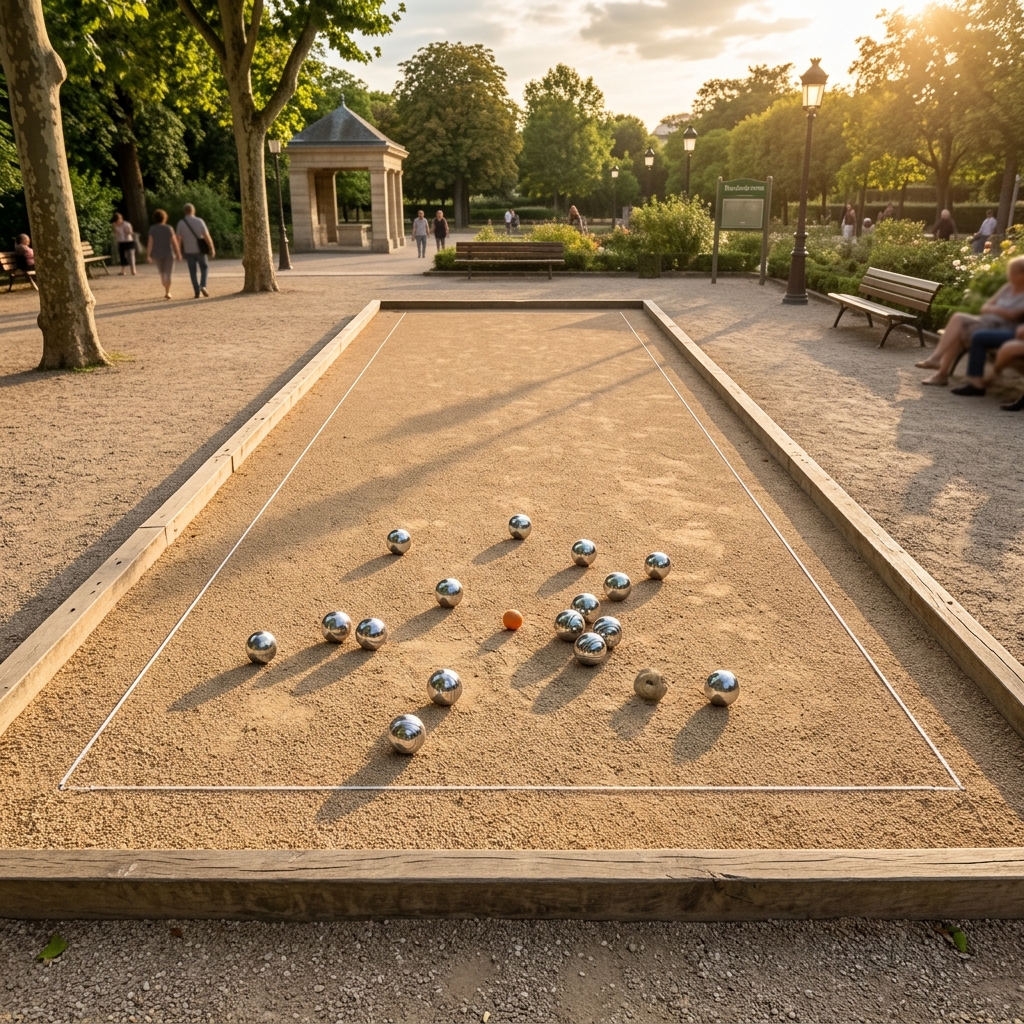
Pétanque Court Dimensions and Setup Guide
Everything you need to know about official FIPJP pétanque court dimensions, marking rules, surface materials, and terrain setup for competitions and home play.
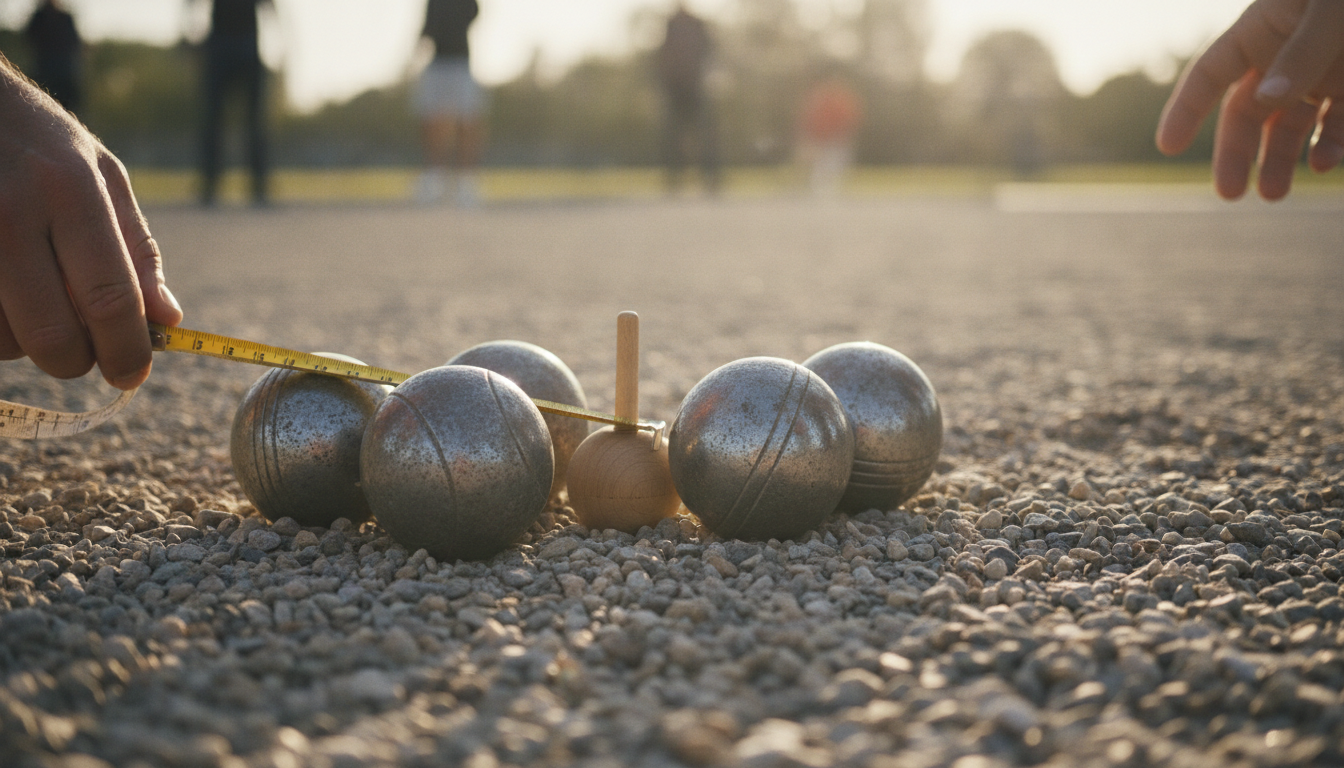
Pétanque Scoring Rules Explained: A Complete Guide
Master the art of counting points in pétanque. Learn basic scoring, dead jack rules, measurement etiquette, and the legendary Fanny tradition.
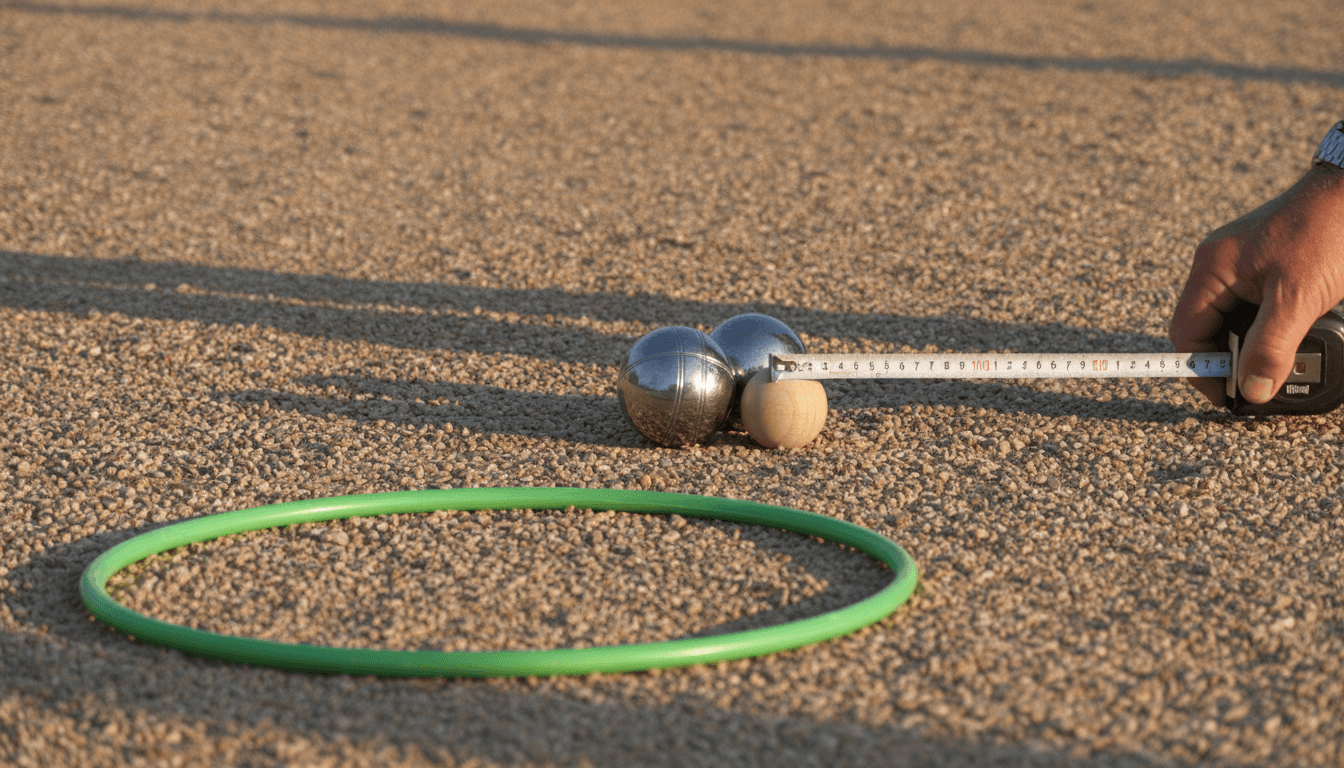
Pétanque Rules 2026: What Actually Changed (and What's a Rumor)
FIPJP confirms no international rule changes for 2026 - despite social media claims. Here's what France's federation actually updated, and what stayed the same.