
Petanque Tournament Formats Explained: Melee, Swiss, Poules & More
A complete guide to every petanque tournament format - melee, super melee, swiss system, poules with elimination, barrage, consolante, and select doublette/triplette.
Petanque Tournament Formats Explained: Melee, Swiss, Poules & More
Walk up to any petanque club on tournament day and you will hear organizers throwing around terms like "melee," "swiss," or "poules." Each format changes how teams are formed, how many games you play, and how a winner is decided. Picking the right one matters just as much as picking the right boules - the wrong format can turn a friendly club day into hours of standing around, or turn a serious championship into a coin flip.
This guide breaks down every major format used in club, regional, and world-level petanque competition.
1. Melee (Concours a la Melee)
The melee is the classic walk-up-and-play format used at most casual club tournaments.
- How it works: Players show up as individuals, not as pre-formed teams. Organizers draw teams randomly, traditionally by collecting one boule from each player in a bag and shaking it, or by throwing boules toward a jack to group players who land closest together. Modern tournaments usually use software with randomly generated player numbers instead.
- Team size: Can be run as doublettes (pairs) or triplettes (three-player teams).
- Best for: Beginners, club social days, and mixing up regular playing partners. Because teammates and opponents are randomized, results carry a large element of luck, so melees are rarely used for serious ranked competition.
Melee Tournante (Rotating Melee) and Super Melee
A variation on the basic melee reshuffles the field between rounds instead of keeping the same random teams for the whole event.
- How it works: After each round, players are regrouped into new random teams, so nobody plays with the same partner twice. In the tournante version played in threes, each player also keeps a fixed role (pointer, shooter) across all the rounds they play, except in doubles where there is no dedicated middle player.
- Scoring: Rather than teams accumulating a tournament record, players are ranked individually by cumulative wins across all rounds, with total point difference (goal average) used to break ties.
- Best for: Guaranteeing everyone plays a minimum number of games regardless of how early they lose, and for social events where meeting new partners is part of the appeal.
2. Select Doublette or Triplette (Fixed Teams)
Most competitive club and regional tournaments use "select" entry instead of a melee.
- How it works: Players register together as a pre-formed team of two (doublette) or three (triplette) and stay together for the entire event. This is the standard entry method for most serious tournaments, including national championships.
- Best for: Competitive players who want consistency with a chosen partner and want results that reflect genuine team skill rather than the luck of a random draw.
Tete-a-Tete (Singles)
The head-to-head singles format, where each of two players competes alone with three boules, is typically run as its own bracket within a broader tournament rather than as a full standalone event structure.
3. Swiss System
The Swiss system solves a real problem: how do you run a fair, competitive tournament with a large field when there isn't time for every team to play every other team?
- How it works: All teams play the same fixed number of rounds. After each round, teams are paired against an opponent with the closest possible matching record, following a strict rule: no two teams ever play each other twice, and wherever possible teams are paired against others on the same score. If an exact match isn't available, a team is paired with the closest score above or below.
- No elimination: Every team plays every round regardless of their record. The winner is whoever has accumulated the best overall record (and point difference as a tiebreaker) after the final round.
- Best for: Large fields where a single-elimination bracket would knock most teams out after one loss, but there isn't time for a full round robin. Qualifying stages of major petanque tournaments frequently use the Swiss system, or a poule format, before moving to knockout rounds for the final placings.
4. Poules (Round-Robin Groups) with Elimination
This is the standard structure for most serious tournaments, including FIPJP World Championships qualifying stages.
- How it works: Teams are divided into small groups called poules (commonly groups of three or four). Within a poule, every team plays every other team once - a true round robin. The top finishers from each poule (often the top one or two) then advance to a direct elimination bracket to decide the final placings.
- Why it's popular: It guarantees every team a minimum number of games (so nobody is eliminated after a single unlucky draw) while still producing a clean knockout bracket for the business end of the competition. Correct seeding into poules matters a lot here - if the strongest teams are bunched into the same poule, one of them gets knocked out early through bad luck rather than bad play.
- World Championship note: FIPJP's Men's World Championship has used poules of three teams (with the top eight seeds from that same edition's own Swiss qualifying stage skipping the first poule match), followed by direct elimination. The Women's and Youth events have used a round-of-16 direct elimination format.
Barrage Format
The barrage is a specific, elegant mini-format used to decide the second qualifier out of a four-team poule without needing tiebreakers or byes.
- How it works: With four teams (A, B, C, D), round one is A vs B and C vs D. In round two, the two round-one winners play each other, and the two round-one losers play each other. After two rounds, one team has two wins (automatically qualified) and one team has zero wins (eliminated), while two teams are tied on one win each. A third and final "barrage" match between those two 1-1 teams decides the second qualifying spot.
- Best for: Four-team poules where organizers want a clean, tiebreaker-free way to send exactly two teams through to the knockout stage.
5. Single and Double Elimination
The most familiar bracket formats from any sport, both are used in petanque, particularly for the finals stage after a poule or Swiss qualifying round.
- Single elimination: Lose once and you're out. Winners advance round by round until one team remains. This format is fast and simple, which makes it ideal when time or court space is limited, but it means a strong team can go home after just one poor game.
- Double elimination: Teams aren't eliminated until they lose twice. After the first round, winners move into a winners' bracket and losers drop into a separate losers' bracket; a team that loses once can still work their way back through the losers' bracket to the final. This guarantees every team at least two games and softens the impact of a single bad match, at the cost of roughly double the number of matches needed compared to single elimination.
Consolante (Consolation Bracket)
Many petanque tournaments pair their main knockout bracket with a parallel "consolante" bracket so that an early loss doesn't end a team's day.
- How it works: Teams that lose in the early rounds of the main event (the "principale") are dropped into the consolante, a separate bracket that plays out alongside the main draw. The consolante has its own winner, so a team that lost early in the principale still has a trophy to play for. Some tournaments run this multiple levels deep, giving out placings in several tiers so players of different standards each get a meaningful competition.
- Best for: All-day club tournaments where organizers want everyone to keep playing meaningful games rather than being knocked out after one loss and sent home.
6. Precision Shooting: The Individual Event
Everything above describes how teams are formed and advance. Many petanque championships - including the FIPJP World Championships - also run a separate individual event alongside the team competition: precision shooting (tir de précision). Rather than forming teams or advancing through brackets, each competitor shoots solo through a fixed sequence of standardized target situations, scored purely on accuracy. See our Shooting Techniques guide for the full format, scoring, and history.
Which Format Should You Choose?
| Format | Team Formation | Games Guaranteed | Best For |
|---|---|---|---|
| Melee | Random, one-off | Depends on bracket | Casual/social club days |
| Melee Tournante / Super Melee | Random, reshuffled each round | High (every round) | Social events, mixing partners |
| Select Doublette/Triplette | Fixed, chosen by players | Depends on bracket | Competitive/ranked play |
| Swiss System | Fixed teams, paired by record | All rounds played | Large fields, limited time |
| Poules + Elimination | Fixed teams, grouped | Poule games + bracket | Regional/national championships |
| Single Elimination | Fixed teams | 1+ (out after one loss) | Fast events, limited courts |
| Double Elimination | Fixed teams | 2+ (out after two losses) | Fairer knockout with more games |
| Consolante | Fixed teams | Extra bracket for early losers | All-day tournaments |
Tips for Tournament Organizers
- Match the format to your field size. A dozen teams can comfortably run a full round robin. Fifty or more teams generally need poules or a Swiss system to stay on schedule.
- Seed your poules. If you know player rankings or past results, spread the strongest teams across different poules so they don't eliminate each other before the knockout stage.
- Plan for a consolante if you have the court capacity. Nothing ends a club tournament's goodwill faster than half the field being eliminated by lunchtime with nothing left to play.
- Bring the right gear. A reliable set of competition boules and a proper measuring tool matter more than usual in elimination formats, where a single close measurement can end your tournament.
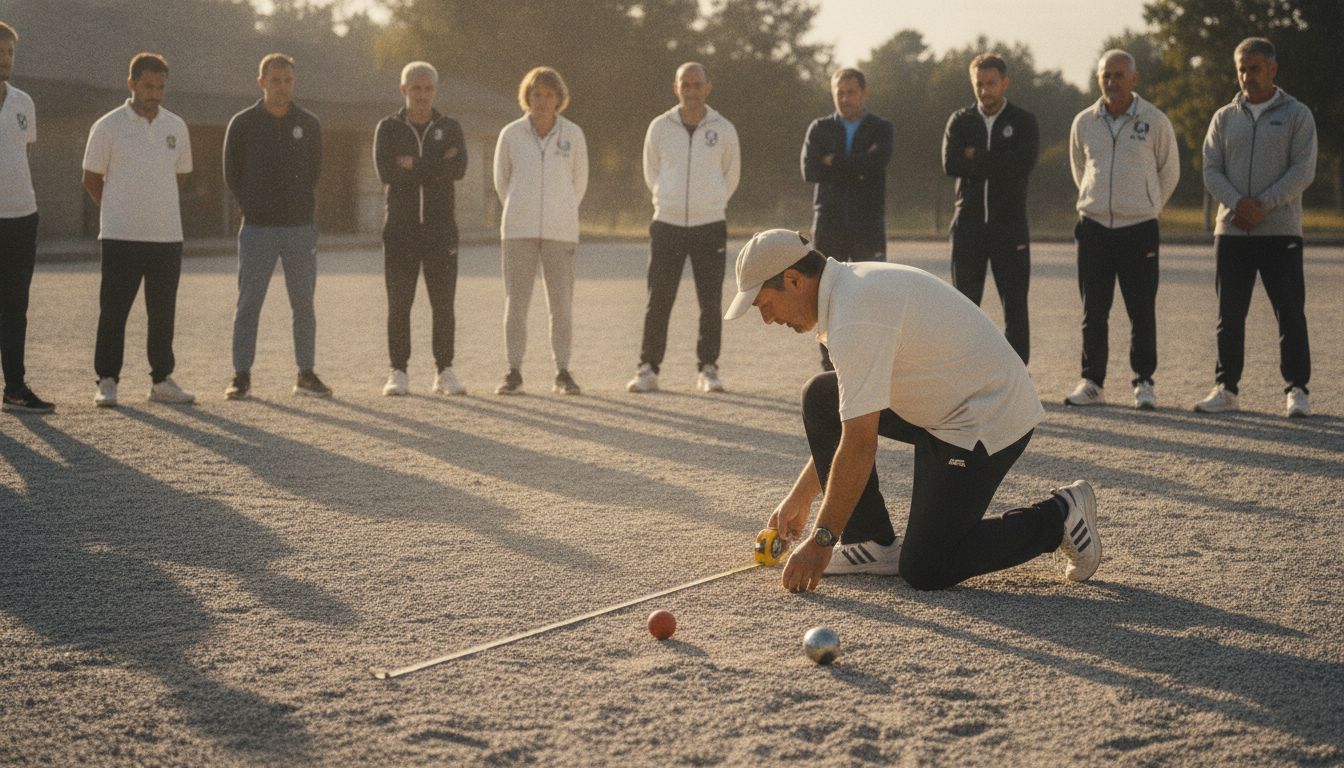
- Arrange for an umpire. Even when your federation doesn't strictly require one, having a certified umpire on hand keeps close measurements and rule disputes fast and final rather than dragging on between teams - see our pétanque umpiring guide for what the role covers and how someone from your club can get certified.
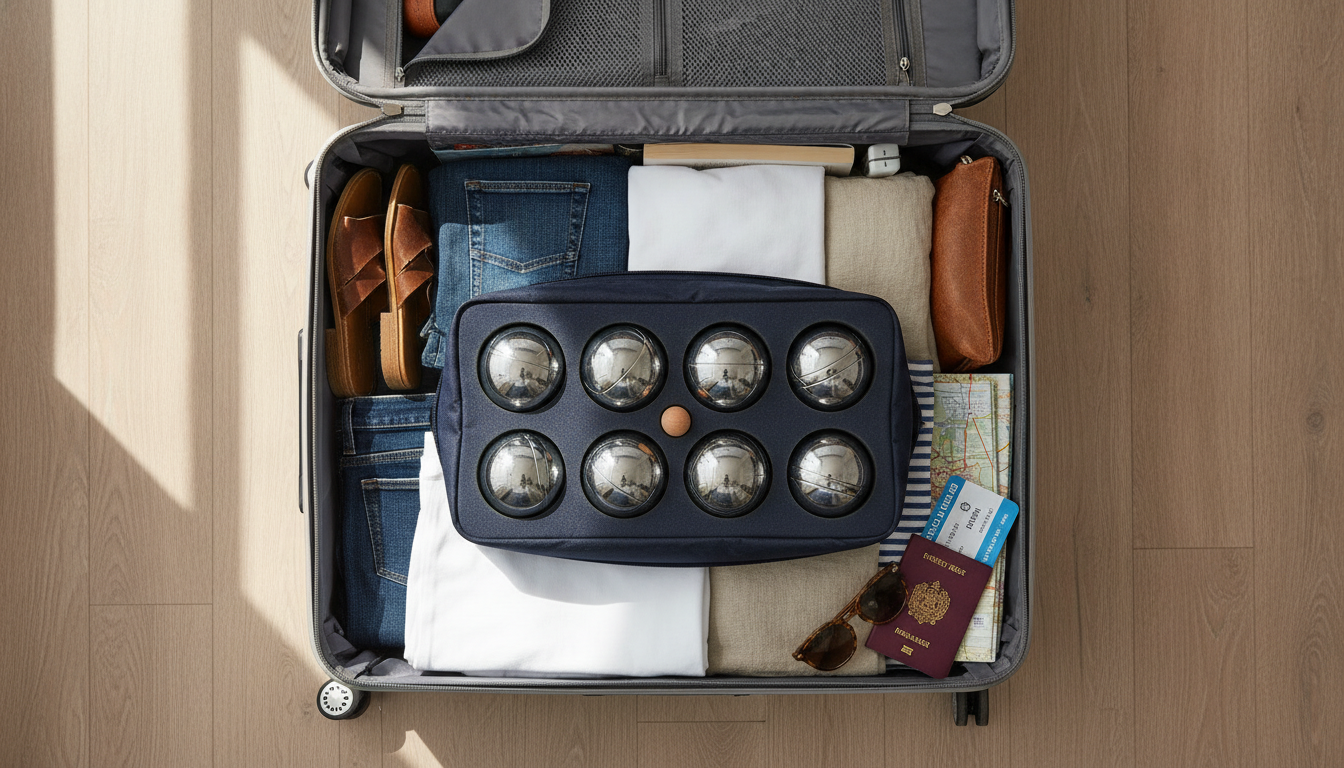
- Flag travel logistics for out-of-town players early. If your tournament draws players flying in, point them to our guide to traveling with pétanque boules - packing rules and checked-baggage weight surprise more first-time traveling players than any other logistics issue.
Keep Learning
Now that you know how tournaments are structured, brush up on the official rules, sharpen your game with our training drills, or dig into advanced strategy before your next event.
Related Articles
How to Umpire a Pétanque Match: Rules & Duties Guide
What a pétanque umpire does, when to call one, the yellow/orange/red card system, and how to get certified - based on the official FIPJP rules.
Traveling With Pétanque Boules: A Flying and Packing Guide
Can you take pétanque boules on a plane? Here's how airport security classifies them, how to pack a set for checked baggage, and how to avoid overweight fees.

Beginner's Guide to Pétanque: Everything You Need to Know
New to pétanque? Learn the basics - how to play, what you need, scoring, and etiquette in this comprehensive beginner's guide.