
Pétanque vs. Lawn Bowls: What's the Difference?
Pétanque and lawn bowls both send a small ball toward a target, but the balls, the throw, and the court could not be more different. Here's the full comparison.
Pétanque vs. Lawn Bowls: What's the Difference?
Anyone who has watched both a pétanque match in a French village square and a lawn bowls match on a pristine green in England or Australia has probably wondered whether these are secretly the same game. They aren't. Beyond the shared goal of getting a ball closer to a small target ball than your opponent, pétanque and lawn bowls diverge in almost every practical way: how the ball is shaped, how it's delivered, what surface it's played on, and even how a match is won.
This guide lays out exactly where the two sports agree and where they part ways.
Quick Comparison Table
| Feature | Pétanque | Lawn Bowls |
|---|---|---|
| Origin | France (Provence), 1907 | England, at least the 13th century |
| Governing body | FIPJP | World Bowls |
| Ball material | Hollow steel | Wood, rubber, or resin, with an internal bias |
| Ball shape | Perfectly round, no bias | Deliberately weighted off-center ("biased"), so it curves |
| Ball size | 70.5-80mm, 650-800g | 112-134mm, up to 1.59kg |
| Target ball name | Cochonnet / jack (25-35mm) | Jack (63-64mm grass / up to 67mm synthetic, 225-453g) |
| Delivery | Thrown underhand through the air | Rolled from a stationary mat |
| Stance | Both feet inside a small circle | One foot on or over a fixed mat |
| Playing surface | Informal gravel, dirt, or sand | Flat, close-mown grass or synthetic "green" |
| Court size | No fixed size for casual play; ~15m x 4m for competition | 31-40m long, in 4.3-5.8m wide "rinks" |
| Winning score | First to 13 points | Varies: e.g., first to 21 in singles, or most points after a set number of ends |
1. History and Heritage
Pétanque
Pétanque is the youngest of the world's major boules sports, created in 1907 in La Ciotat, near Marseille. Legend credits Jules Lenoir, a player whose rheumatism no longer let him take the running approach used in jeu provençal, the game pétanque grew out of. His friends redesigned the game around a fixed, feet-together stance, close enough to the target that a long approach was no longer necessary. The name comes from the Provençal pès tancats, "feet fixed."
Lawn Bowls
Lawn bowls is far older. England's Southampton Old Bowling Green is widely cited as the world's oldest bowling green still in use, played on since 1299 (Chesterfield Bowling Club's green, dated to 1294, is sometimes named as an older rival claim), and the game's roots likely stretch back further still. It was popular (and periodically banned) among English kings and commoners alike for centuries before being formally codified with standardized rules in the 19th century. From Britain it spread throughout the Commonwealth, and it has been a full Commonwealth Games sport since the very first Games in 1930.
2. Equipment: Steel Boules vs. Biased Bowls
This is where the two sports differ most fundamentally.
Pétanque Boules
Pétanque boules are hollow steel spheres, small enough to fit in one hand, and perfectly round with no internal weighting.
- Diameter: 70.5mm to 80mm
- Weight: 650g to 800g
- Behavior: Because they're perfectly round, a pétanque boule travels in a straight line, whether thrown through the air or rolled along the ground.
Lawn Bowls
Lawn bowls are large, solid balls made of wood, rubber, or resin, and every one of them is deliberately weighted off-center, a property called "bias."
- Diameter: 112mm to 134mm (roughly the size of a grapefruit)
- Weight: Up to 1.59kg (about 3.5lbs), several times heavier than a pétanque boule
- Behavior: The bias makes a lawn bowl curve as it slows down, so players deliberately aim off to one side and let the ball "draw" its way back toward the jack, an entirely different skill from throwing a straight-flying pétanque boule.
The Target Ball
Both sports (in English, at least) call their small target ball a "jack," which causes no end of confusion between the two.
- In pétanque, it's properly called the cochonnet ("little pig"), a small wood or synthetic ball 25-35mm across.
- In lawn bowls, the jack is a plain white or yellow sphere, larger than pétanque's: 63-64mm and 225-285g on an outdoor grass green, or up to 67mm and 382-453g on synthetic and indoor greens, under World Bowls' official Laws of the Sport.
3. The Playing Surface
Pétanque: Rough and Ready
Pétanque is built to be played almost anywhere: hard-packed gravel, dirt paths, crushed stone, even sand. The unevenness of the ground is part of the game, since a bad bounce is always possible and players learn to read the terrain. Casual games need no marked boundaries at all, and even competitive terrains (about 15m x 4m) are simple to lay out with string.
Lawn Bowls: The Manicured Green
Lawn bowls is the opposite: it demands a flat, precisely maintained playing surface called a "green," historically natural grass cut extremely short and kept level, though synthetic surfaces are now common too. A green is divided into parallel "rinks," each 4.3m to 5.8m wide and 31m to 40m long, so many games can run side by side. Preparing and maintaining a bowls green is a specialist, ongoing job in a way that a pétanque terrain never requires.
4. Delivery Technique
Pétanque: Thrown from a Fixed Circle
Pétanque's defining rule is the stance: both feet must stay inside a small circle (35-50cm) on the ground, without leaving it, until the boule has landed. From that fixed position, the boule is thrown underhand through the air, palm facing down, typically with a flick of backspin at release that helps a steel boule stop quickly rather than skid on landing.
Lawn Bowls: Rolled from a Mat
Lawn bowls has its own fixed-position rule, but the ball is never thrown, only rolled. The player places at least part of one foot on or directly over a rectangular delivery mat and, from a smooth backswing-to-follow-through bowling action (closer to an underarm cricket bowl than a throw), releases the bowl at or near ground level so it rolls the length of the green. Stepping off the mat, or releasing before any part of the foot is on or over it, is a "foot fault." Unlike bocce, there is no walking or running approach before release; the whole delivery happens from that one fixed spot.
5. Rules and Scoring
Both sports share the same basic scoring idea: after all the balls for an "end" have been played, the team with the closest ball to the target scores one point for every one of its balls that is nearer than the opponent's closest ball.
- Pétanque: Matches are almost always played to a flat 13 points, however many ends (called "mènes") that takes.
- Lawn Bowls: Scoring format varies by discipline. Singles matches are commonly played to 21 points, capped at a set number of ends (often 21); team formats (pairs, triples, fours) are instead played over a fixed number of ends (commonly 15-21 depending on the competition), with the highest score after the last end winning, regardless of whether either side reaches a particular target number.
6. Where Each Game Thrives
Pétanque's strongholds: France (where it was born and remains a national pastime), Francophone Africa (Madagascar, Senegal, Benin, Cameroon, and dozens more), and Southeast Asia (Thailand, Cambodia, Laos, and Vietnam), plus a growing presence across Europe and the Americas. The FIPJP counts well over 100 member federations.
Lawn bowls' strongholds: England and the wider United Kingdom, Australia, New Zealand, South Africa, and Canada, where it has deep club traditions and thousands of dedicated greens. It has been part of the Commonwealth Games program continuously since 1930, giving it an international competitive platform pétanque has never had at that level.
Which Should You Play?
Choose Pétanque if:
- You want something you can set up anywhere, on gravel, dirt, or a beach, with no dedicated facility required.
- You like a fast-paced, social game that fits in a small bag.
- You enjoy the tactical mix of "pointing" (landing close) and "shooting" (knocking an opponent's boule away in mid-air).
Choose Lawn Bowls if:
- You have access to a bowls club or green, or enjoy the idea of a more formal, club-based sport.
- You're drawn to the specific skill of reading and controlling a biased ball's curve.
- You want a sport with an established competitive pathway through national leagues up to the Commonwealth Games.
Frequently Asked Questions
Are pétanque boules and lawn bowls interchangeable?
No. Pétanque boules are far too small, light, and perfectly round to be useful in lawn bowls, and a biased lawn bowl would be unplayable (and against the rules) in pétanque, where a straight-rolling, straight-flying ball is required.
Why does a lawn bowl curve but a pétanque boule doesn't?
A lawn bowl is manufactured with a permanent internal weight offset, called bias, that's specific to lawn bowls. A pétanque boule has no such offset; it's turned to be as close to a perfect, evenly weighted sphere as possible, precisely so it flies and rolls in a straight line.
Is lawn bowls the same as crown green bowls?
Not quite. Crown green bowls, popular in parts of northern England and the Midlands, is played on an unlevel, "crowned" green (higher in the middle) with no marked rinks or fixed length, whereas the "lawn bowls" compared here (sometimes called "flat green bowls") is played on a level green with straight, standardized rinks under World Bowls' Laws of the Sport.
Ready to get started?
- Check out our Beginner's Guide to Pétanque
- Learn how to choose your first boules
- Browse our official pétanque rules guide
- See how pétanque compares to another rolling boules game in Pétanque vs. Bocce Ball
- Curious about pétanque's French cousins? See Pétanque vs. Jeu Provençal vs. Boule Lyonnaise
- Wondering how it compares to America's fastest-growing sport? See Pétanque vs. Pickleball
- Curious how it stacks up against America's favorite tailgate game? See Pétanque vs. Cornhole
- Curious how it compares to a fast, athletic net game? See Pétanque vs. Spikeball
- Curious how it compares to horseshoes, one of the closest games to pétanque in spirit? See Pétanque vs. Horseshoes
- Curious how it compares to kubb, a Swedish block-throwing game especially popular alongside pétanque in Sweden? See Pétanque vs. Kubb
- Curious how it compares to croquet, a mallet-and-hoop game that may share French royal-court roots with pétanque? See Pétanque vs. Croquet
- Curious how it compares to boccia, the Paralympic sport built on the same boules family and adapted for athletes with disabilities? See Pétanque vs. Boccia
- Curious how it compares to curling, a winter sport that swaps pétanque's fixed circle for a sliding stone steered by sweeping brooms on ice? See Pétanque vs. Curling
- Curious how it compares to a court game where a disc is pushed with a cue instead of a ball thrown by hand? See Pétanque vs. Shuffleboard
- Curious how it compares to darts, a stationary precision game thrown overhand at a fixed board indoors instead of underhand at a moving jack outdoors? See Pétanque vs. Darts
- Curious how it compares to bowling, an indoor game where the goal is to knock down ten pins rather than land closest to a target? See Pétanque vs. Bowling
- Curious how it compares to Mölkky, Finland's own numbered-skittle throwing game invented in 1996? See Pétanque vs. Mölkky
Related Articles
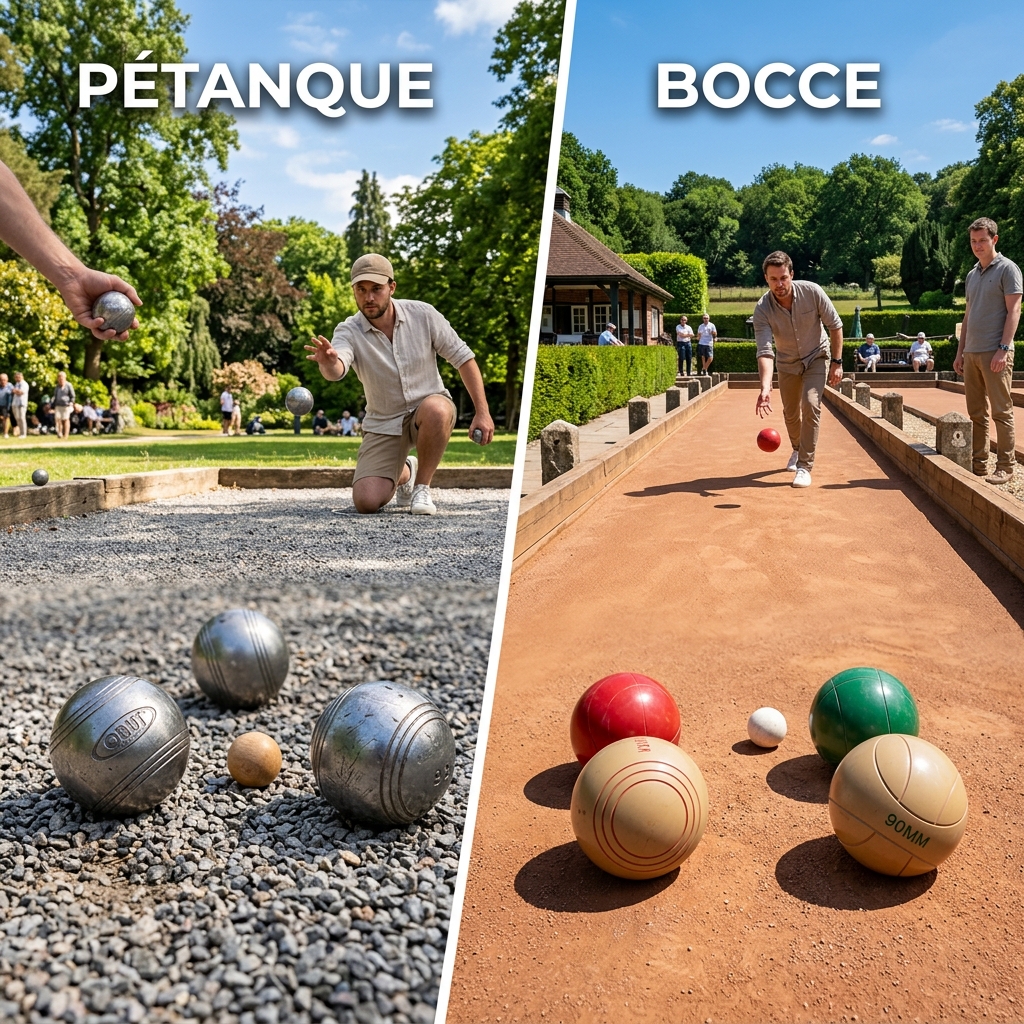
Pétanque vs. Bocce Ball: The Ultimate Comparison Guide
Confused between pétanque and bocce? Discover the key differences in rules, equipment, court dimensions, and throwing techniques in this definitive guide.
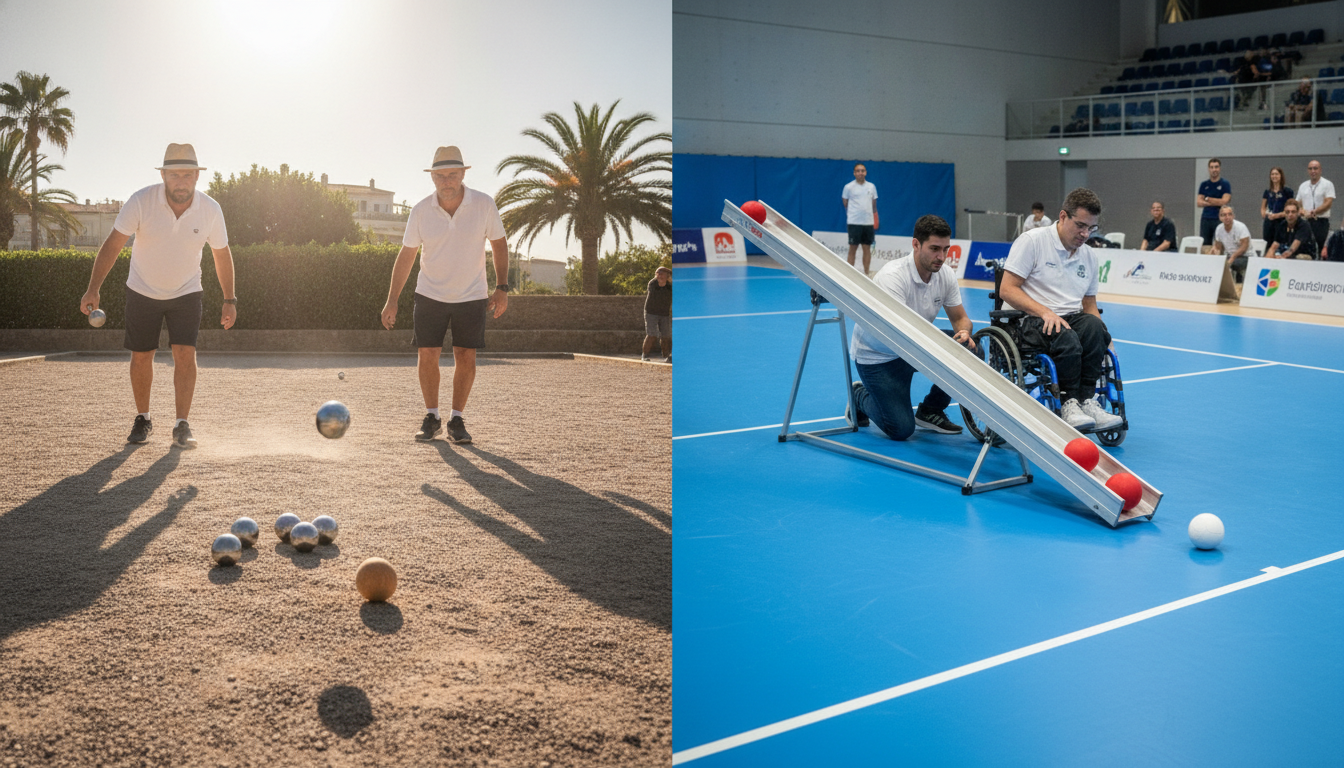
Pétanque vs. Boccia: The Complete Comparison Guide
Pétanque and boccia come from the same boules family and share a 'closest ball wins' scoring system, but boccia is a classified Paralympic sport played indoors. Compare rules, gear and more.
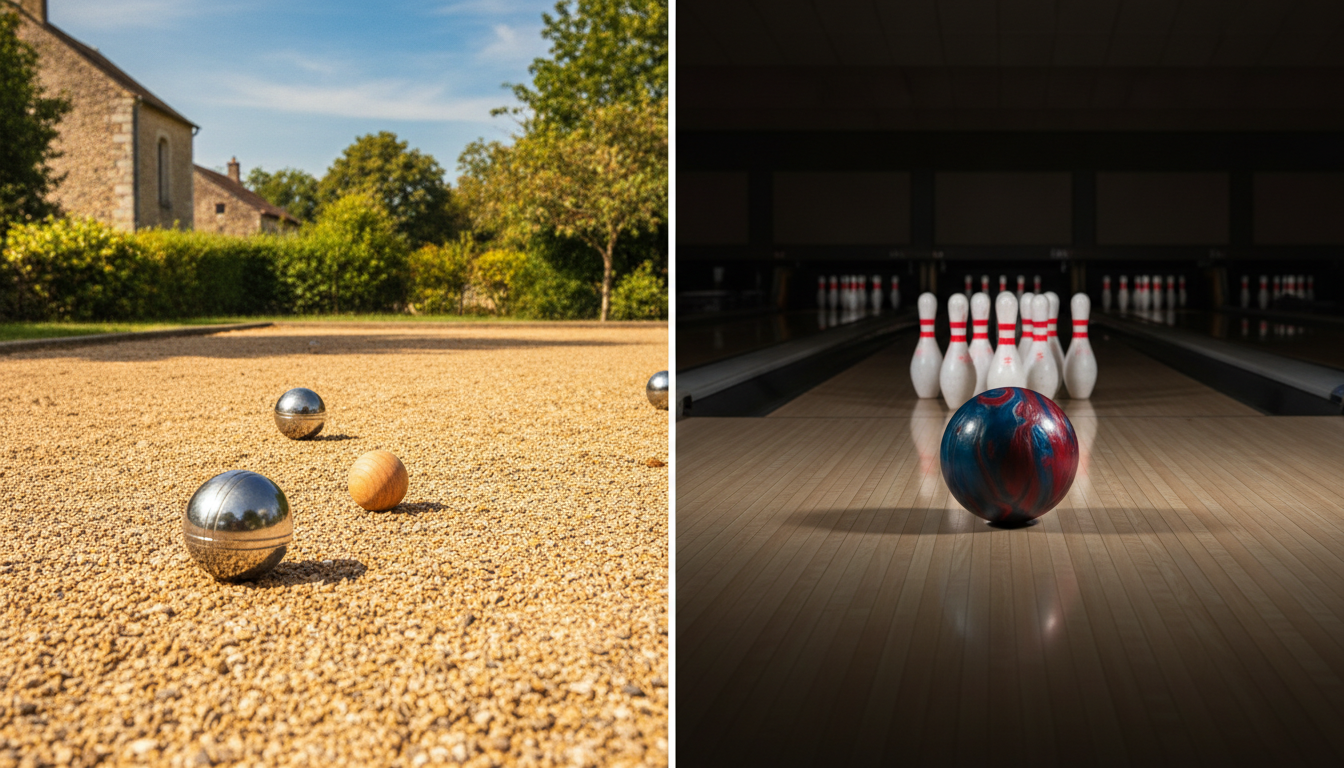
Pétanque vs. Bowling: The Complete Comparison Guide
Pétanque and ten-pin bowling are both precision games about landing closest to (or knocking down) a target, but one is played on outdoor gravel and the other on an indoor lacquered lane. Compare history, gear, and rules.