
Pétanque vs. Jeu Provençal vs. Boule Lyonnaise Explained
Pétanque, jeu provençal, and boule lyonnaise are often confused. Compare their history, boules, stance, and courts to see how these three French games differ.
Pétanque vs. Jeu Provençal vs. Boule Lyonnaise: What's the Difference?
Walk into almost any French bar and mention "boules," and someone will eventually bring up jeu provençal or boule lyonnaise as if they were just older names for pétanque. They aren't. All three are genuinely distinct games with their own rules, equipment, and governing bodies, and pétanque is actually the youngest of the three, not an old regional name for the others.
This guide untangles the family tree: what each game is, how they differ, and where each one is still played today.
Quick Comparison Table
| Feature | Pétanque | Jeu Provençal (La Longue) | Boule Lyonnaise (Sport-Boules) |
|---|---|---|---|
| Origin | 1907, La Ciotat | 19th century, Provence | 18th century, Lyon |
| International federation | FIPJP | FIPJP (same body as pétanque) | FIB |
| Stance | Fixed circle, feet together | Three-step running approach ("les trois pas") | Running approach along the terrain |
| Boule diameter | 70.5-80mm | 70.5-80mm (same spec as pétanque) | 90-110mm |
| Boule weight | 650-800g | 650-800g (same spec as pétanque) | 900-1200g (reduced minimums for youth/women) |
| Throwing distance | Jack thrown 6-10m | 15-20m | Played on a ~27.5m court |
| Where it thrives today | Worldwide, 100+ countries | Provence (regional) | Lyon / Rhône-Alpes region (regional, with world championships) |
1. Three Games, One Family Tree
Pétanque, jeu provençal, and boule lyonnaise are all "boules sports" - games played with heavy balls thrown or rolled toward a smaller target ball - but they're governed separately. Since 2021, all of them sit under the umbrella of the World Pétanque and Bowls Federation (WPBF), which was formed after the previous umbrella body, the CMSB (Confédération Mondiale des Sports de Boules, founded 1985 in Monaco), dissolved in April 2020. Three international federations make up that structure:
- FIPJP (Fédération Internationale de Pétanque et Jeu Provençal) governs both pétanque and jeu provençal.
- FIB (Fédération Internationale de Boules) governs boule lyonnaise, known internationally as "sport-boules" or "bocce volo."
- CBI (Confederazione Boccistica Internazionale) governs raffa, a related Italian discipline. It's a different sport from the general "bocce ball" played in backyards and covered in our pétanque vs. bocce guide - raffa is one specific competitive Italian boules discipline, while "bocce" as most people use the word covers the broader family of Italian-American lawn games.
In France, pétanque and jeu provençal are run together by a single national federation, the FFPJP (Fédération Française de Pétanque et de Jeu Provençal), while boule lyonnaise has its own national body, the FFSB (Fédération Française du Sport-Boules).
2. History and Origins
Boule Lyonnaise: The Oldest of the Three
Boule lyonnaise is the elder of the family. It emerged in 18th-century Lyon under names like "jeu de boules" or "jeu national," was formally organized as a sport in 1850 with the founding of the Clos Jouve society, and held its first properly regulated tournament in Lyon in 1894, drawing around 1,200 players. It was codified nationally by the UNFB (Union Nationale des Fédérations Boulistes) in 1927.
Jeu Provençal: The "Three Steps" Game
Jeu provençal - also known as "la longue" or "les trois pas" - developed in the 19th century in southern France as a variant that let players take a running start before throwing. Its defining rule is the three-step approach: a player builds momentum, plants their final step, and releases the boule in one fluid motion, similar in spirit to boule lyonnaise but played with pétanque-sized equipment. The first French championship of jeu provençal was held in 1946.
Pétanque: Born from Jeu Provençal in 1907
Pétanque is the newest of the three, and it was created specifically to remove the running approach that defines both of its ancestors. According to the story documented in our history of pétanque, the game was invented in 1907 in La Ciotat when a jeu-provençal player, Jules Hugues (nicknamed "Lenoir"), found the running throw too painful to perform because of rheumatism. His friend Ernest Pitiot suggested he play from a fixed position instead - and pétanque, from the Provençal pès tancats ("feet together" or "feet planted"), was born. The FFPJP was founded in 1945 and the FIPJP followed in 1958, both in Marseille.
3. Equipment: Same Boules, Different Boules
This is one of the most practical differences if you're deciding what to buy.
Pétanque and jeu provençal share identical boule specifications under FIPJP rules: hollow metal boules 70.5-80mm in diameter and 650-800g in weight. If you already own a set of pétanque boules, they'll work for a casual game of jeu provençal too - see our guide to choosing your first boules if you're shopping for a set.
Boule lyonnaise uses a completely different, larger boule. Under FFSB rules, standard boule lyonnaise balls measure 90-110mm in diameter and weigh 900-1200g (with reduced minimums for youth and women's categories), traditionally made from a cupro-aluminium alloy (a mix of aluminium, copper, nickel, and iron) rather than the stainless steel or carbon steel typical of pétanque boules today. These are not interchangeable with pétanque or jeu provençal boules - they're noticeably bigger and heavier in the hand.
4. Stance and Throwing Technique
Pétanque is defined by its stationary stance: both feet stay inside a circle 35-50cm across, and the player releases the boule with an underhand toss and a wrist-flick backspin, without ever taking a step.
Jeu provençal's signature move is "les trois pas" - the three-step approach. Rather than pétanque's still circle, a player gathers information on the target, builds a short running approach, plants their final stride, and releases the boule in one continuous motion, closer to an athletic throw than pétanque's controlled flick.
Boule lyonnaise also uses a running approach, but its competitive disciplines are more specialized than either of the other two games. Two individual events define top-level competition: tir de précision (precision shooting), where a player has 11 throws to hit 11 different target boules surrounded by obstacles on a 6-meter mat, and tir progressif (progressive shooting), a five-minute event where the player runs the length of the terrain striking targets set in six pits along a 5.2-meter mat, testing speed, endurance, and accuracy all at once. There's also a traditional team game closer in spirit to pétanque's pointing and shooting.
5. Court and Terrain
Pétanque needs the least space and the least preparation. Casual games are played on almost any semi-flat surface - gravel, dirt, packed sand - with no fixed boundaries required. Competitive play uses a marked area of roughly 15m x 4m. See our court dimensions guide for the full FIPJP specification.
Jeu provençal needs a longer strip to accommodate its 15-20 meter throwing distances: a minimum width of 3.5-4m and a minimum length of 24m.
Boule lyonnaise is played on the most standardized court of the three: an official rectangle 27.5m long and 2.5-4m wide, split into two playing zones by a 12.5m neutral central area - a layout built around its running throws and specialized shooting disciplines rather than pétanque's informal circle-based play.
6. Where Each Game Thrives Today
Pétanque is the global success story of the family. It's played in more than 100 countries by an estimated 20 million people, from village squares in France to city parks in Southeast Asia and North America.
Jeu provençal stayed close to home. It's still actively played and organized through French championships, but it remains concentrated in its Provençal heartland rather than spreading internationally the way pétanque did.
Boule lyonnaise also stayed regional - centered on Lyon and the Rhône-Alpes region - but it has a genuine international competitive scene of its own through the FIB, including its own World Championships and a recurring place in the boules sports program at the World Games (contested there in editions including 2001, 2009, and 2017).
Which Family Member Should You Try?
- Choose pétanque if you want the most accessible, portable, and internationally popular version - a set of boules and a patch of gravel is all you need. Start with our beginner's guide.
- Choose jeu provençal if you already play pétanque and want a more physically demanding variant that rewards a strong running throw and covers more ground per point.
- Choose boule lyonnaise if you're drawn to a more specialized, precision-and-athleticism discipline with its own dedicated equipment and competitive structure, especially if you're near Lyon or another Rhône-Alpes club.
Keep exploring
- Compare pétanque with its Italian cousin in Pétanque vs. Bocce Ball
- Compare pétanque with the curving, biased balls of Pétanque vs. Lawn Bowls
- Read the full story of pétanque's 1907 origin in The History of Pétanque
- New to the game? Start with our Beginner's Guide to Pétanque
Related Articles
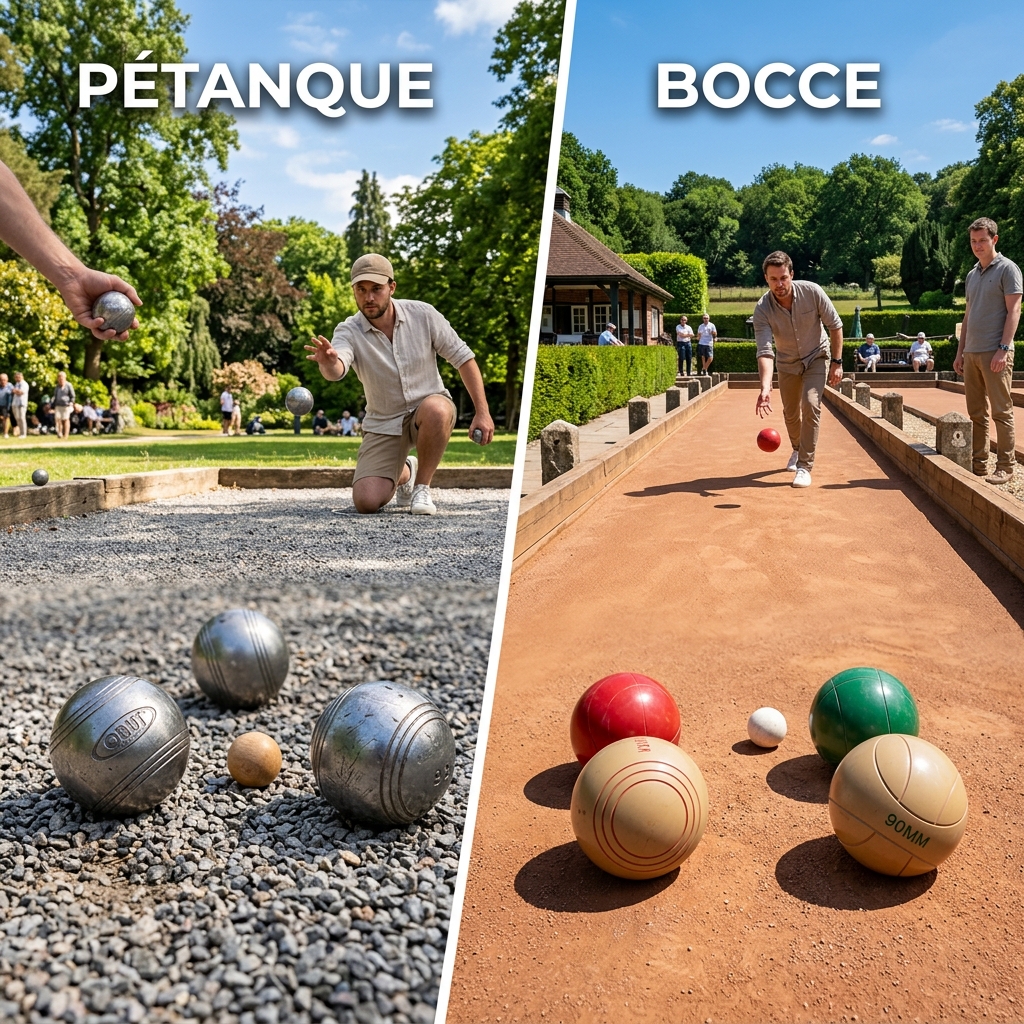
Pétanque vs. Bocce Ball: The Ultimate Comparison Guide
Confused between pétanque and bocce? Discover the key differences in rules, equipment, court dimensions, and throwing techniques in this definitive guide.
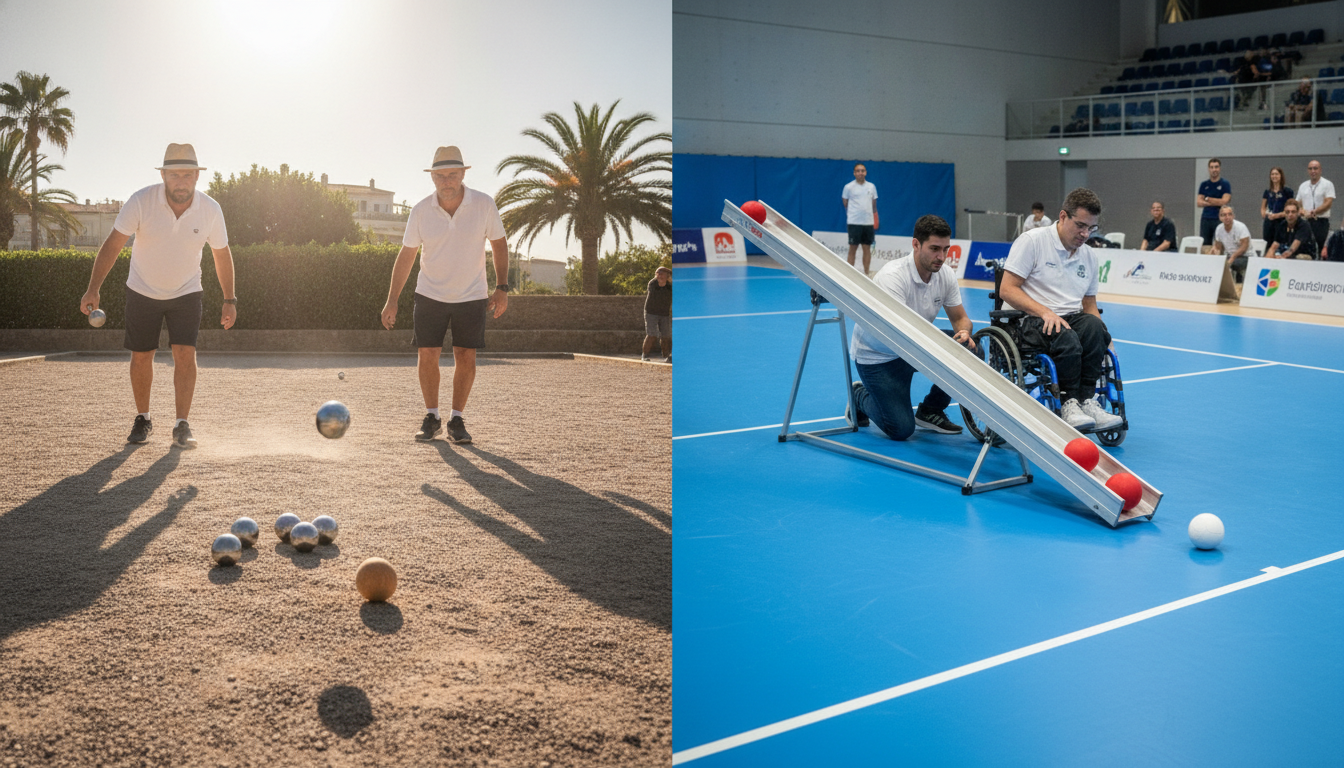
Pétanque vs. Boccia: The Complete Comparison Guide
Pétanque and boccia come from the same boules family and share a 'closest ball wins' scoring system, but boccia is a classified Paralympic sport played indoors. Compare rules, gear and more.
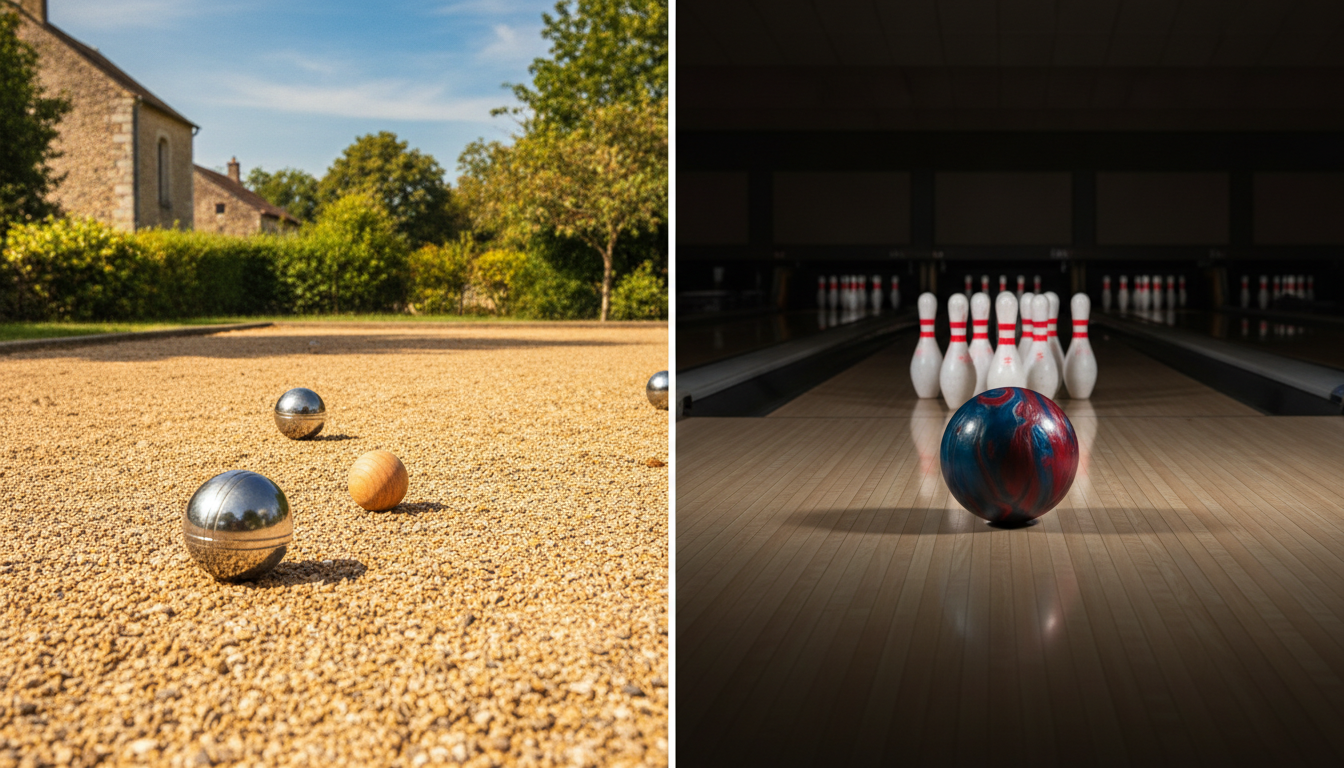
Pétanque vs. Bowling: The Complete Comparison Guide
Pétanque and ten-pin bowling are both precision games about landing closest to (or knocking down) a target, but one is played on outdoor gravel and the other on an indoor lacquered lane. Compare history, gear, and rules.