
Pétanque vs. Curling: The Complete Comparison Guide
Pétanque and curling are both precision games where the closest object wins, but one needs gravel and the other engineered ice. Compare history, gear, and rules.
Pétanque vs. Curling: The Complete Comparison Guide
Both games boil down to the same simple idea: get your object closer to a target than your opponent's, and you score. Past that shared logic, pétanque and curling could hardly be less alike. One is played with metal balls thrown by hand on sun-baked gravel; the other is played with 20kg granite stones slid across engineered ice by teammates who sweep the surface in front of them to steer the shot. Curling is also the only sport on this site's comparison list that requires a refrigerated playing surface - every other game pétanque has been measured against needs nothing but open ground.
This guide compares the two across history, equipment, playing surface, gameplay, scoring, and Olympic status, so you know exactly what sets them apart.
Quick Comparison Table
| Feature | Pétanque | Curling |
|---|---|---|
| Origin | La Ciotat, France (1907) | Scotland (16th century; earliest evidence a stone dated 1511) |
| Governing body | FIPJP (international, since 1958) | World Curling (founded 1966 as the International Curling Federation, renamed World Curling Federation in 1990, then World Curling in 2024) |
| Equipment | Hollow steel boules (70.5-80mm, 650-800g) + wooden jack | Granite stones (17.24-19.96kg, max 914mm circumference) + brooms |
| Playing surface | Gravel, dirt, sand, or lawn - outdoors, no fixed surface needed | A refrigerated, precisely maintained ice sheet, 44.5-45.7m x 4.4-5.0m |
| Team size | 1v1, 2v2, or 3v3 (singles, doubles, triples) | 4 players per team (team play) or 2 players (mixed doubles) |
| Core action | Throw or lob a boule underhand toward the jack; can also shoot an opponent's boule away | Slide a stone from a hack, steer it in flight via sweeping; can also strike an opponent's stone away |
| Physical demand | Low - played standing still in a fixed circle | Moderate - a lunging slide delivery plus sustained, aerobic sweeping |
| Winning format | First to 13 points | Highest score after 8 or 10 ends (team play) or 8 ends (mixed doubles) |
| Olympic status | Not Olympic (IOC-recognized since 1986) | Full Olympic medal sport since 1998; mixed doubles added in 2018 |
1. History and Origins
Pétanque: A Century-Old French Adaptation
Pétanque was invented in 1907 in La Ciotat, a coastal town near Marseille. A local merchant, Jules Hugues (nicknamed "Lenoir"), suffered from rheumatism that made the running throw of jeu provençal too painful. His friend Ernest Pitiot, who ran the café attached to the local boulodrome, suggested Hugues play from a fixed position instead, both feet planted inside a circle. The name comes from the Provençal pès tancats ("feet fixed"). The sport has been governed internationally by the FIPJP since 1958, and the IOC formally recognized it in 1986, though it has never been granted full Olympic status.
Curling: Centuries Older, From Frozen Scottish Ponds
Curling's roots run far deeper. The earliest physical evidence is a curling stone inscribed with the date 1511, found near Dunblane, Scotland, and the word "curling" itself first appeared in print in 1620 in Perth. For centuries it was played informally on frozen lochs and ponds using flat river stones, before the Royal Caledonian Curling Club, founded in Edinburgh in 1838 (earning its royal charter in 1843), formalized the sport's equipment and rules and became known as curling's "mother club." The international game followed much later: representatives of Scotland, Canada, the United States, Sweden, Norway, and Switzerland met in Perth in 1965 and declared the International Curling Federation established on 1 April 1966 in Vancouver. The body was renamed the World Curling Federation in 1990, and simplified its name again to World Curling in 2024. It now counts 74 member associations worldwide, with Monaco among the most recent to join in 2024.
2. Equipment: Hollow Steel Boules vs. Granite Stones
The two sports could not have less in common when it comes to gear.
Pétanque Boules
Pétanque is played with hollow metal balls, usually steel, held palm-down and thrown or lobbed underhand.
- Diameter: 70.5mm to 80mm
- Weight: 650g to 800g
- Target ball: the cochonnet (jack), a small wooden or synthetic ball about 30mm across
See our guide on how to choose your first boules for buying advice.
Curling Stones and Brooms
Curling stones are solid polished granite, quarried almost exclusively from a small number of sites (most famously Ailsa Craig, an island off the Scottish coast), fitted with a handle bolted through the center.
- Weight: 17.24kg to 19.96kg (38 to 44 lb)
- Circumference: maximum 914mm (36 inches)
- Height: minimum 114.3mm (4.5 inches)
- Running surface: a narrow concave ring on the underside, just 6.4mm to 12.7mm wide, that actually touches the ice
- Brooms: every team also carries synthetic-headed brooms (or "brushes"), used to sweep the ice directly in front of a moving stone
3. The Playing Surface
Pétanque's terrain is part of the game's character; curling's is engineered to millimeter precision, and that difference defines both sports.
Pétanque: Play Almost Anywhere
Pétanque needs no dedicated court - a gravel driveway, a dirt path, a beach, or a park lawn all work. Competitive matches use a marked lane, with the FIPJP specifying 15m x 4m for national and international championships (a 12m x 3m minimum is allowed for other sanctioned competitions). See our full court dimensions guide for the official specs.
Curling: A Refrigerated Sheet of Ice
Curling is played on a "sheet" of ice measuring 146 to 150 feet long by 14.5 to 16.5 feet wide (roughly 44.5-45.7m x 4.4-5.0m), kept at a precise temperature and pebbled with fine water droplets that freeze into tiny bumps, reducing friction so stones can travel the full length of the sheet. At each end sits the house: three concentric rings 4, 8, and 12 feet in diameter (about 1.22m, 2.44m, and 3.66m) centered on the button. Key distances on the sheet include the hog line to the tee line (21ft/6.4m) and the tee line to the back line (6ft/1.83m). Building and maintaining ice to this standard requires dedicated refrigeration - something no other sport on this site's comparison list needs.
4. How You Play: Fixed Circle vs. Slide-and-Sweep
Pétanque: Precision Throwing From a Fixed Circle
Players stand with both feet inside a small circle (35-50cm) and throw the boule underhand, typically adding backspin with a wrist flick so it stops quickly where it lands. Players can also aim to knock an opponent's boule away rather than simply landing close to the jack. Our pointing and shooting technique guides cover the two core throwing styles in depth.
Curling: Delivery, Direction, and Sweeping
A curler delivers the stone from a hack (a fixed foot block), lunging forward in a controlled slide and releasing the stone with a slight rotation of the handle, which makes it curve, or "curl," as it travels - the effect the sport is named for. Once the stone is released, the thrower's job is largely done; two teammates then sweep the ice just in front of the moving stone with brooms, briefly warming and smoothing the surface to reduce friction. This lets sweepers extend a stone's distance and reduce how much it curls, giving a team live, physical control over a shot after it has already left the thrower's hand - something pétanque, where the boule is fully committed the instant it leaves the hand, has no equivalent for. A team's skip stands at the far end calling the target line and instructing when to sweep. Like pétanque, curling shots can also be purely defensive or offensive: a "takeout" strikes an opponent's stone out of the house, much like a pétanque shooter clearing an opposing boule.
5. Scoring
Pétanque
Games are played to 13 points. After all boules are thrown in a round (a mène), only one team scores: one point for every boule closer to the jack than the opponent's closest boule. See our full scoring guide for the details.
Curling
Each team throws eight stones per end (two per player in four-player team play), for sixteen stones total per end. Once all stones are thrown, only the team with the stone closest to the button scores: one point for every one of that team's stones nearer the button than the opponent's closest stone. A standard game runs 8 or 10 ends (10 ends is standard for Olympic team play); mixed doubles, curling's two-player Olympic format since 2018, uses 8 ends with each team throwing five stones plus one stone pre-placed in the house before the end begins, capping any single end at six points.
6. Physical Demands and Accessibility
Pétanque is played from a stationary circle and remains genuinely competitive for players well into their 80s and 90s, placing almost no demand on speed, jumping, or cardio fitness. FIPJP competition already welcomes wheelchair users and players with limited mobility into the same events as everyone else - see our guide on pétanque for players with disabilities for how that works in practice.
Curling asks more of the body than its calm television presentation suggests. The delivery itself is a controlled, low lunge that demands balance and leg strength, and sweeping hard for the length of a sheet, repeated many times across an end, is genuinely aerobic work - studies of competitive curlers have measured heart rates comparable to moderate-intensity exercise during sweeping bursts. Curling also has a well-established wheelchair discipline: wheelchair curling has been a Paralympic sport since the 2006 Turin Winter Paralympics, played without sweeping (since players cannot brace and sweep from a chair) and with a stick-assisted delivery available for stones. Both sports, in their own ways, have built genuine room for players with limited mobility into their competitive structures.
7. Popularity and Olympic Status
Curling has been a full Olympic medal sport since the 1998 Nagano Winter Olympics, after the IOC granted it official status in 1992; a two-player mixed doubles event joined the Olympic program at Pyeongchang 2018. At the most recent Winter Games, Milano Cortina 2026, Canada (skipped by Brad Jacobs) won men's gold over Great Britain, Sweden (skipped by Anna Hasselborg) won women's gold over Switzerland, and Sweden's Rasmus and Isabella Wranå won mixed doubles gold over the United States - a rare double gold for one country across the women's and mixed doubles events. World Curling now counts 74 member national associations, with strongholds across Canada, Scandinavia, and the traditional curling nations of Scotland, Switzerland, and the United States.
Pétanque's footprint is older in France specifically but sits entirely outside the Olympic program: it is the dominant boules sport in France, with major strongholds across Southeast Asia (notably Thailand, Laos, and Cambodia) and parts of Northern Europe like Sweden. The IOC recognized pétanque in 1986, six years before curling secured full Olympic status, but pétanque has never crossed that line - the FIPJP and the World Pétanque and Bowls Federation continue to press its case today.
Which One Are You Looking For?
You're probably thinking of Pétanque if:
- You want a relaxed, low-impact game you can play with any age group, using nothing but a bag of boules and a jack, anywhere outdoors.
- You don't have access to ice and want a precision target game you can play year-round on a driveway or in a park.
- You're curious about a sport that has real Olympic ambitions but has not yet achieved them.
You're probably thinking of Curling if:
- You're researching a full Olympic sport, its ice sheet, or the physics behind sweeping and stone curl.
- You're comparing team roles like skip, lead, second, and third, or the mixed doubles format.
- You watched the Winter Olympics and want to understand the rules behind what you saw.
Frequently Asked Questions
Is curling similar to pétanque?
Only in the broad sense that both are precision target games where the object closest to a smaller mark wins the point. Beyond that, they are opposites: pétanque is played outdoors on gravel, dirt, or lawn with metal boules thrown by hand, while curling is played indoors on engineered ice with 17-20kg granite stones that are slid, not thrown, and steered by teammates sweeping the ice in front of them.
What is the main difference between pétanque and curling?
Surface and delivery. Pétanque needs no special surface at all and boules are thrown or lobbed underhand from a standing circle. Curling requires a refrigerated, precisely maintained ice sheet, and its granite stones are released with a sliding delivery from a hack, then guided in flight by two teammates sweeping the ice ahead of them.
Why do curlers sweep the ice?
Sweeping briefly melts and smooths the ice directly in front of a moving stone, which reduces friction. That lets the stone travel farther and curl less, giving the two sweepers on a team real-time control over a stone's distance and path after it has already been released.
Is pétanque or curling older?
Curling, by centuries. The earliest physical evidence is a curling stone inscribed with the date 1511, found near Dunblane, Scotland, and the word "curling" appeared in print in 1620. Pétanque is a 20th-century invention, created in 1907 in La Ciotat, France.
Is pétanque or curling an Olympic sport?
Curling is a full Olympic sport, with medal status since the 1998 Nagano Games and a mixed doubles event added in 2018. Pétanque is not Olympic - the IOC recognized it in 1986, but it has never been added to the Olympic program.
Ready to get started?
- Check out our Beginner's Guide to Pétanque
- Browse the best pétanque sets for backyard and garden play
- Learn the official pétanque scoring rules
- Curious how pétanque compares to other backyard games? See Pétanque vs. Pickleball, Pétanque vs. Cornhole, Pétanque vs. Bocce Ball, and Pétanque vs. Lawn Bowls
- Curious how it compares to a fast, athletic net game? See Pétanque vs. Spikeball
- Curious how it compares to horseshoes, one of the closest games to pétanque in spirit? See Pétanque vs. Horseshoes
- Curious how it compares to kubb, a Swedish block-throwing game especially popular alongside pétanque in Sweden? See Pétanque vs. Kubb
- Curious how it compares to croquet, a mallet-and-hoop game that may share French royal-court roots with pétanque? See Pétanque vs. Croquet
- Curious how it compares to boccia, the Paralympic sport built on the same boules family and adapted for athletes with disabilities? See Pétanque vs. Boccia
- Curious how it compares to a court game where a disc is pushed with a cue instead of a ball thrown by hand? See Pétanque vs. Shuffleboard
- Curious how it compares to darts, a stationary precision game thrown overhand at a fixed board indoors instead of underhand at a moving jack outdoors? See Pétanque vs. Darts
- Curious how it compares to bowling, an indoor game where the goal is to knock down ten pins rather than land closest to a target? See Pétanque vs. Bowling
- Curious how it compares to Mölkky, Finland's own numbered-skittle throwing game invented in 1996? See Pétanque vs. Mölkky
Related Articles
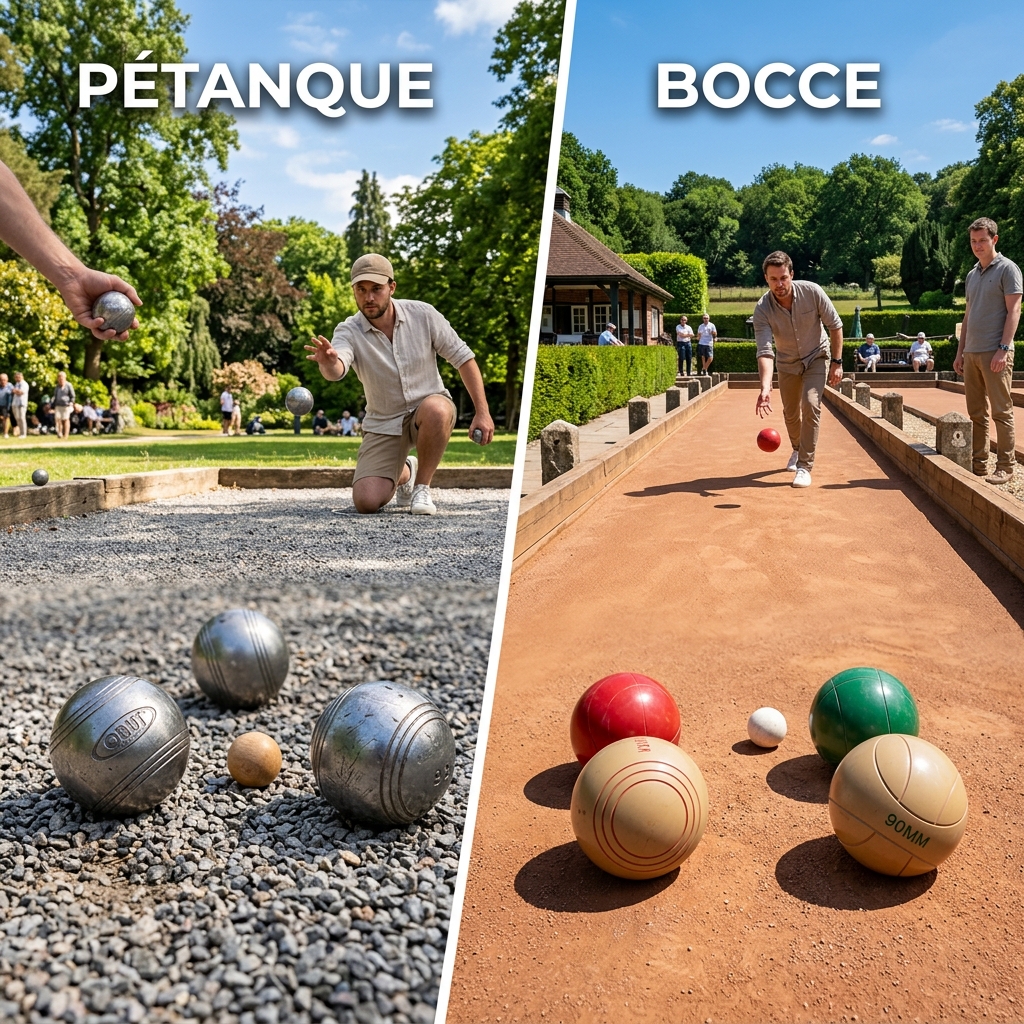
Pétanque vs. Bocce Ball: The Ultimate Comparison Guide
Confused between pétanque and bocce? Discover the key differences in rules, equipment, court dimensions, and throwing techniques in this definitive guide.
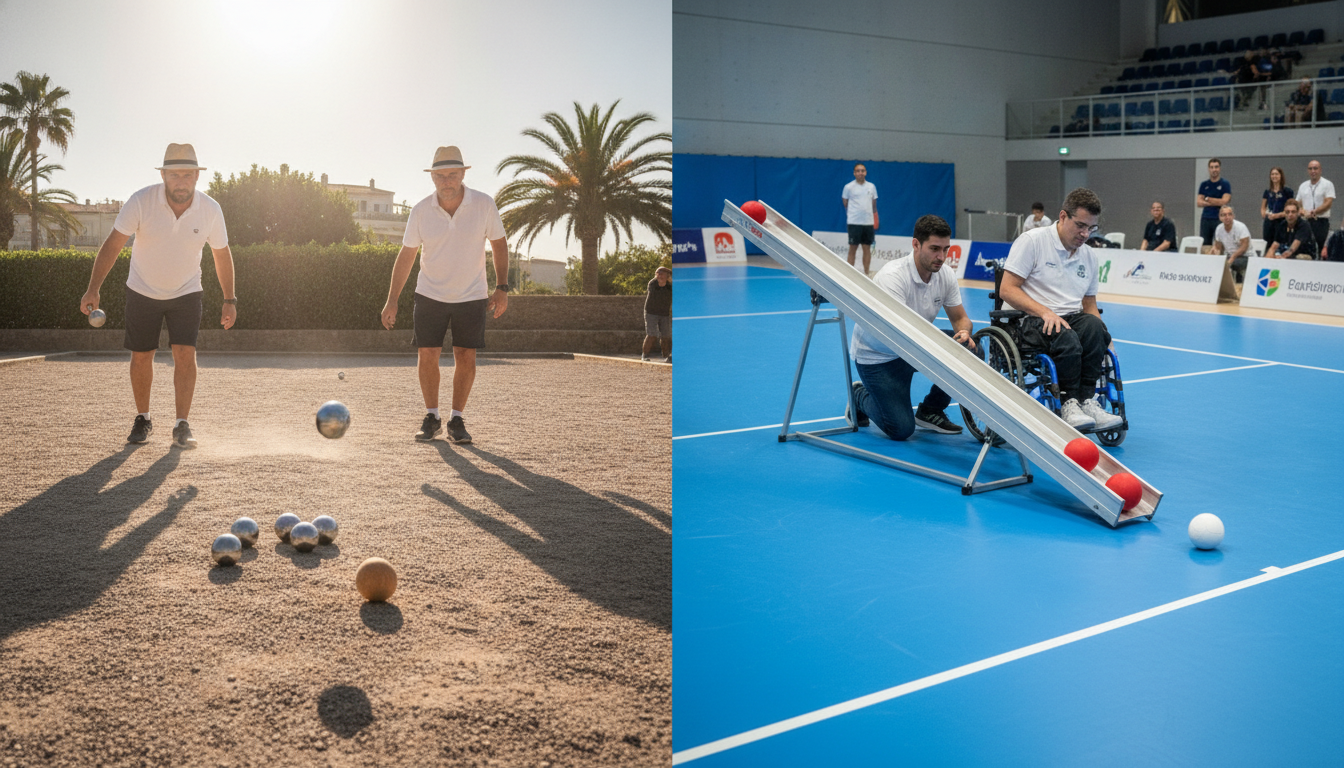
Pétanque vs. Boccia: The Complete Comparison Guide
Pétanque and boccia come from the same boules family and share a 'closest ball wins' scoring system, but boccia is a classified Paralympic sport played indoors. Compare rules, gear and more.
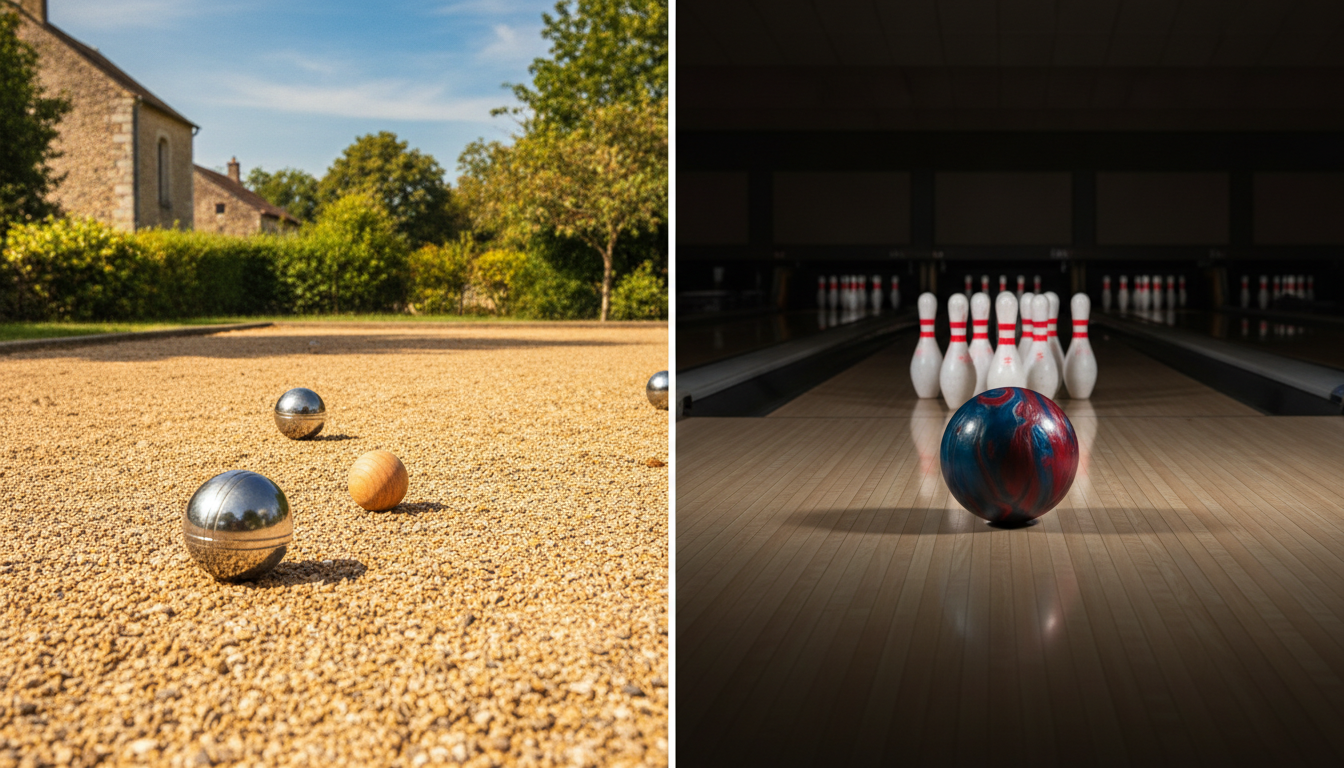
Pétanque vs. Bowling: The Complete Comparison Guide
Pétanque and ten-pin bowling are both precision games about landing closest to (or knocking down) a target, but one is played on outdoor gravel and the other on an indoor lacquered lane. Compare history, gear, and rules.