
Pétanque vs. Bocce Ball: The Ultimate Comparison Guide
Confused between pétanque and bocce? Discover the key differences in rules, equipment, court dimensions, and throwing techniques in this definitive guide.
Pétanque vs. Bocce Ball: The Ultimate Comparison Guide
If you've ever walked through a sunny park in Europe or a coastal town in the U.S., you've likely seen people tossing balls on a dirt or gravel court. To the untrained eye, these games might look identical. However, they are distinct sports with unique histories, equipment, and rules.
The two most popular "boules" sports - an umbrella term for games played with heavy balls - are Pétanque and Bocce Ball.
This guide breaks down the key differences between these two beloved games so you can decide which one is right for your next backyard gathering or competitive match.
Quick Comparison Table
| Feature | Pétanque | Bocce Ball |
|---|---|---|
| Origin | France (Provence) | Italy (Ancient Rome) |
| Ball Material | Hollow Steel | Solid Resin/Wood |
| Ball Size | Small (70.5-80mm) | Large (approx. 107mm) |
| Stance | Fixed Circle (Feet Together) | Walk and Release (Approach) |
| Throwing Style | Underhand, Backspin | Bowling/Rolling Style |
| Court Type | Informal (Gravel, Dirt) | Formal (Prepared Court) |
| Target Ball | Cochonnet (Jack) | Pallino |
1. History and Heritage
Pétanque
Pétanque is the "youngest" of the major boules sports. It was born in 1907 in the town of La Ciotat, near Marseille in southern France. The game was created to allow a local player who suffered from rheumatism to play without having to run or take a long approach. The name comes from the Provençal expression pès tancats, meaning "feet together" or "feet fixed."
Bocce Ball
Bocce (the plural of the Italian word boccia, meaning "ball") has much older roots. While the modern game was codified in Italy, its ancestors date back to the Roman Empire and even ancient Egypt. It spread throughout Europe and eventually to the Americas, where it remains a staple of Italian-American culture.
2. Equipment: Boules vs. Bocce
One of the most immediate differences is the equipment you'll hold in your hand.
Pétanque Boules
Pétanque is played with hollow metal balls (usually steel). They are relatively small - roughly the size of an orange - and are designed to be held with the palm facing down.
- Diameter: 70.5mm to 80mm
- Weight: 650g to 800g
- Surface: Usually has "striations" (grooves) to help identify your boules.
Bocce Balls
Bocce balls are solid and significantly larger and heavier than pétanque boules. Traditionally made of wood, modern bocce balls are almost always made of a heavy resin or composite material.
- Diameter: Standard size is approx. 107mm (4.2 inches)
- Weight: Approx. 920g (2 lbs)
- Surface: Smooth or with simple circular patterns.
The Target Ball
In both games, you aim for a smaller target ball.
- In pétanque, it is called the cochonnet (little pig) or jack. It is small (30mm) and made of wood or synthetic material.
- In bocce, it is called the pallino or bochín. It is larger than a cochonnet (approx. 40-50mm) and usually made of the same resin as the bocce balls.
3. The Court and Playing Surface
This is where the two sports differ most in terms of accessibility.
Pétanque: The "Anywhere" Game
Pétanque is designed to be played on natural, uneven surfaces. You'll find games on hard-packed gravel, dirt paths, or even sandy beaches. The unpredictability of the ground is a core part of the strategy.
- Dimensions: No fixed boundaries are required for casual play, though competitive matches use a 15m x 4m area.
- Boundaries: Usually informal or marked with string.
Bocce: The "Refined" Court
Bocce is typically played on a long, rectangular court with high sideboards. The surface is meticulously prepared and usually made of packed clay, fine gravel, or specialized synthetic turf.
- Dimensions: Regulation courts run about 13 feet (4m) wide; length varies by federation, from roughly 87 feet (26.5m) under United States Bocce Federation rules to around 91 feet (28m) cited by some other sources.
- Boundaries: The sideboards allow players to "bank" their shots, much like in billiards.
4. Throwing Technique and Stance
Pétanque: The Fixed Circle
The most defining rule of pétanque is the stance. You must stand with both feet inside a small circle (35-50cm) and your feet must remain on the ground until the boule has landed.
- The Grip: Palm facing down.
- The Motion: An underhand toss where you flick your wrist at the end to add backspin. This backspin helps the metal boule stop quickly on impact.
Bocce: The Bowling Approach
Bocce allows for more movement. Players typically take a few steps - similar to a bowling approach - up to a foul line before releasing the ball.
- The Grip: Palm facing up or down, depending on the shot.
- The Motion: The ball is usually rolled along the ground. While "lofted" shots are allowed in some variations (like Raffa), the goal is often a smooth roll toward the pallino.
5. Rules and Scoring
The basic objective is the same in both: get your balls closer to the target than your opponent.
- Scoring: After all balls are thrown, the team with the closest ball gets 1 point for every ball that is closer to the target than the opponent's closest ball.
- Winning:
- Pétanque: Games are almost always played to 13 points.
- Bocce: Games are often played to 12 or 16 points, depending on local tradition or tournament rules.
Which Should You Play?
Choose Pétanque if:
- You want to play in a park, on your driveway, or at the beach without a specialized court.
- You enjoy a game that fits in a small bag and can be taken anywhere.
- You like the strategic challenge of "backspin" and "shooting" (knocking away opponent boules in mid-air).
Choose Bocce if:
- You have access to a dedicated bocce court or have the space to build one.
- You prefer the "rolling" feel of a heavier, solid ball.
- You enjoy the "bank shot" mechanics provided by court sideboards.
Frequently Asked Questions
Can you play Pétanque with Bocce balls?
Not really. Bocce balls are too heavy and large to be thrown with the "palm down" pétanque technique, and they wouldn't survive the impact on a typical pétanque gravel terrain without chipping.
Which game is more popular?
Pétanque is more popular in France, Southeast Asia, and Northern Europe. Bocce is more popular in Italy, the United States, and Australia. Globally, both have millions of players.
Is one harder than the other?
Both are "easy to learn, hard to master." Pétanque's "fixed feet" rule requires more upper-body control and wrist technique, while Bocce's longer distance requires better weight control and rolling accuracy.
Ready to get started?
- Check out our Beginner's Guide to Pétanque
- Learn how to choose your first boules
- Browse our official pétanque rules guide
- Curious about pétanque's own French cousins? See Pétanque vs. Jeu Provençal vs. Boule Lyonnaise
- Wondering how pétanque stacks up against the curving, biased balls of lawn bowls? See Pétanque vs. Lawn Bowls
- Wondering how it compares to America's fastest-growing sport? See Pétanque vs. Pickleball
- Curious how it stacks up against America's favorite tailgate game? See Pétanque vs. Cornhole
- Curious how it compares to a fast, athletic net game? See Pétanque vs. Spikeball
- Curious how it compares to horseshoes, one of the closest games to pétanque in spirit? See Pétanque vs. Horseshoes
- Curious how it compares to kubb, a Swedish block-throwing game especially popular alongside pétanque in Sweden? See Pétanque vs. Kubb
- Curious how it compares to croquet, a mallet-and-hoop game that may share French royal-court roots with pétanque? See Pétanque vs. Croquet
- Curious how it compares to boccia, the Paralympic sport built on the same boules family and adapted for athletes with disabilities? See Pétanque vs. Boccia
- Curious how it compares to curling, a winter sport that swaps pétanque's fixed circle for a sliding stone steered by sweeping brooms on ice? See Pétanque vs. Curling
- Curious how it compares to a court game where a disc is pushed with a cue instead of a ball thrown by hand? See Pétanque vs. Shuffleboard
- Curious how it compares to darts, a stationary precision game thrown overhand at a fixed board indoors instead of underhand at a moving jack outdoors? See Pétanque vs. Darts
- Curious how it compares to bowling, an indoor game where the goal is to knock down ten pins rather than land closest to a target? See Pétanque vs. Bowling
- Curious how it compares to Mölkky, Finland's own numbered-skittle throwing game invented in 1996? See Pétanque vs. Mölkky
- New to pétanque's French vocabulary? Our Pétanque Terminology Glossary defines cochonnet, tireur, pointeur, and dozens more terms.
Related Articles
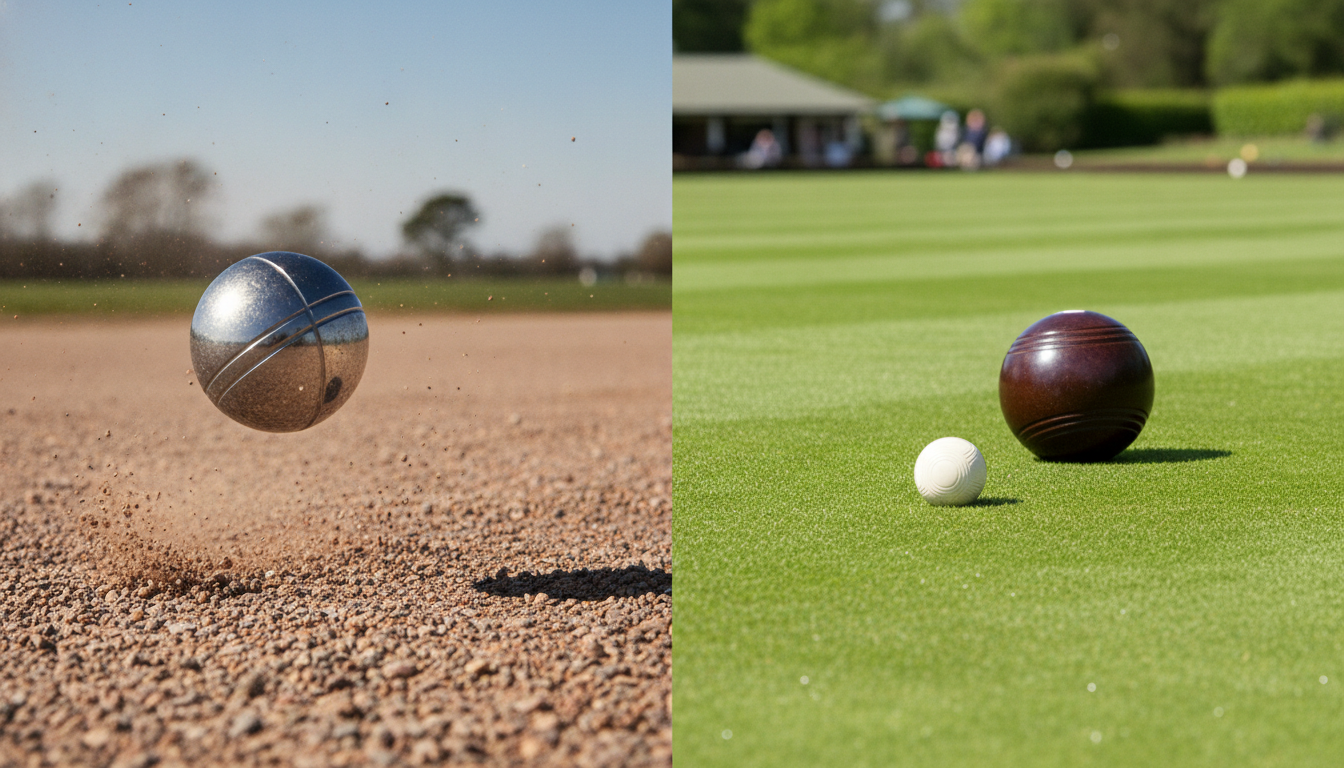
Pétanque vs. Lawn Bowls: What's the Difference?
Pétanque and lawn bowls both send a small ball toward a target, but the balls, the throw, and the court could not be more different. Here's the full comparison.
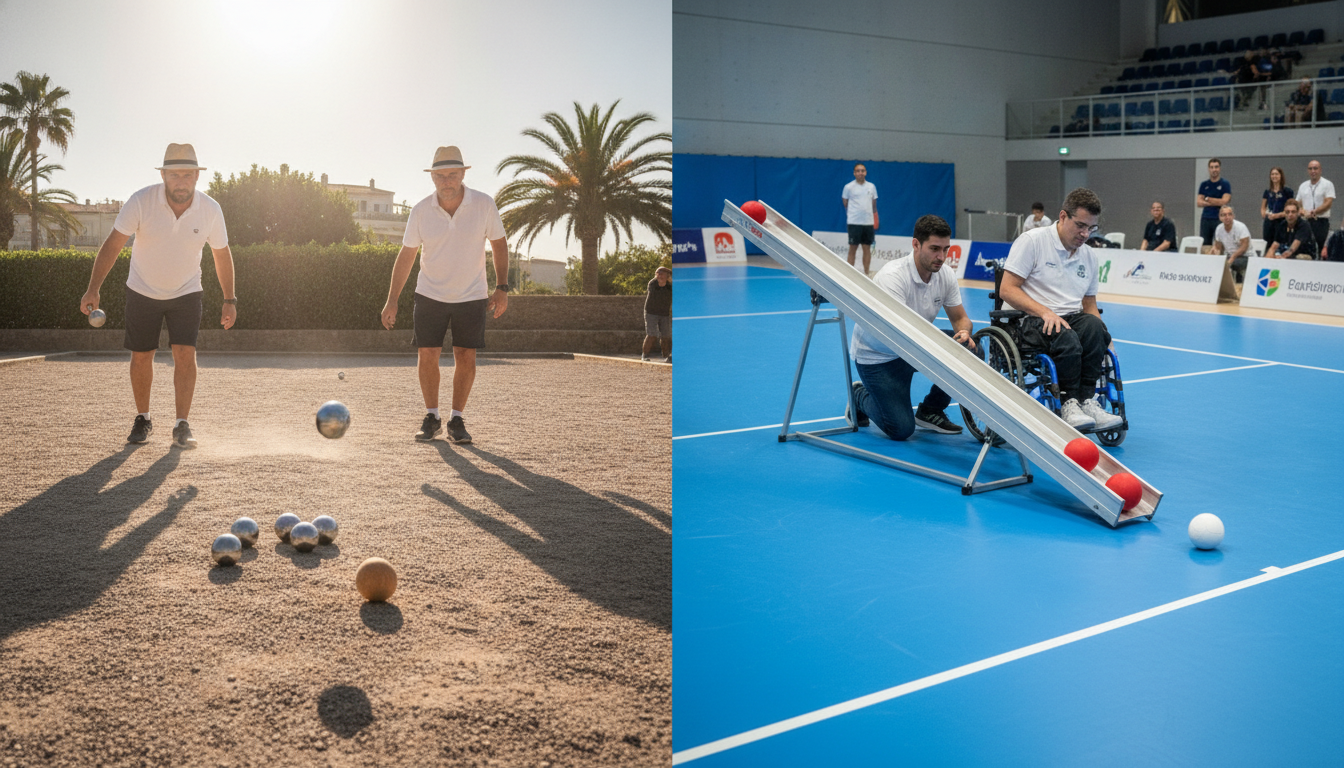
Pétanque vs. Boccia: The Complete Comparison Guide
Pétanque and boccia come from the same boules family and share a 'closest ball wins' scoring system, but boccia is a classified Paralympic sport played indoors. Compare rules, gear and more.
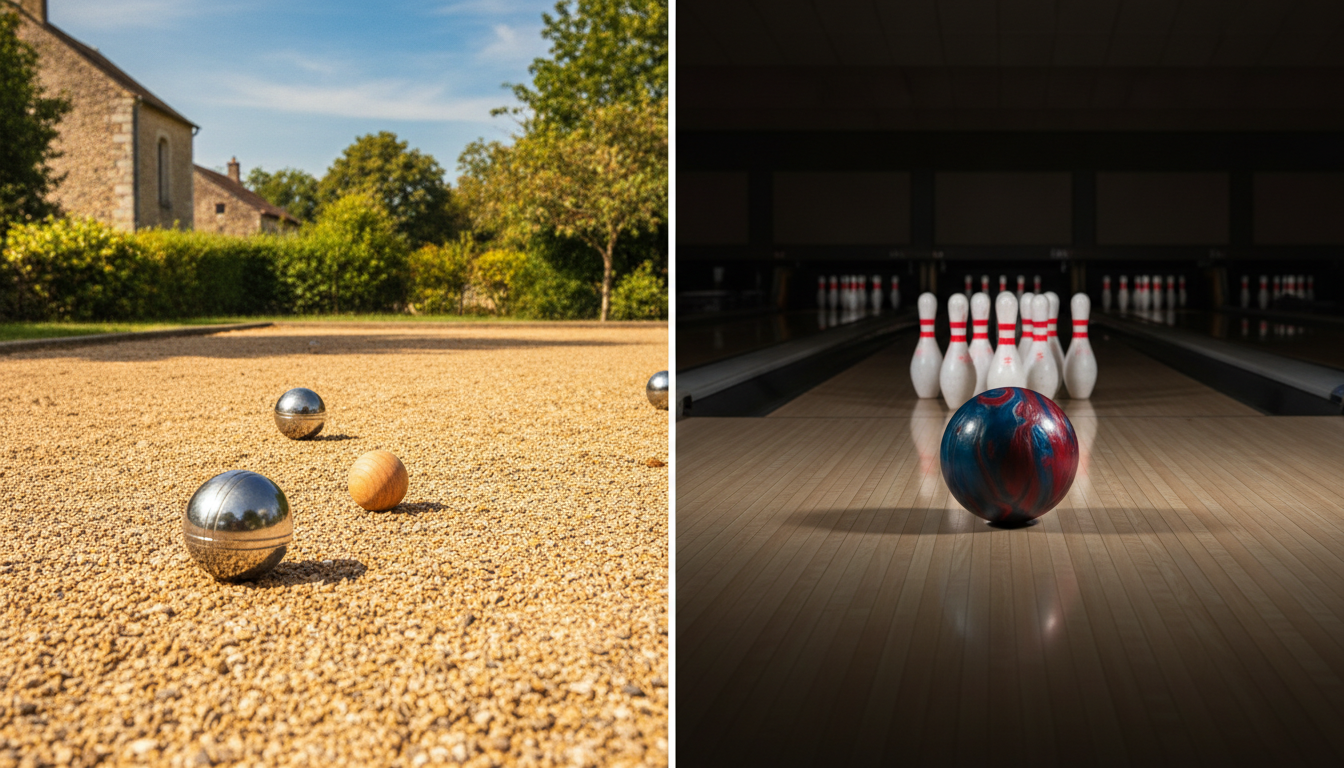
Pétanque vs. Bowling: The Complete Comparison Guide
Pétanque and ten-pin bowling are both precision games about landing closest to (or knocking down) a target, but one is played on outdoor gravel and the other on an indoor lacquered lane. Compare history, gear, and rules.