
Pétanque vs. Pickleball: The Complete Comparison Guide
Pétanque and pickleball are both booming backyard games, but the history, equipment, courts and scoring could not be more different. Compare them here.
Pétanque vs. Pickleball: The Complete Comparison Guide
Pickleball has been the fastest-growing sport in the United States for four years running, and its explosive rise has pulled a lot of casual players toward "backyard sport" comparisons of all kinds. Pétanque, the French game of tossing metal balls toward a small wooden target, keeps coming up in those conversations - both are easygoing, social, low-cost-to-start games that people of very different ages and fitness levels can play together.
But beyond that surface-level appeal, pétanque and pickleball have almost nothing in common. One is a throwing and precision game played on loose ground with no net; the other is a racket sport played on a hard court with a net, closer to tennis than to any "boules" game. This guide breaks down exactly how they differ, and which one might suit you better.
Quick Comparison Table
| Feature | Pétanque | Pickleball |
|---|---|---|
| Origin | La Ciotat, France (1907) | Bainbridge Island, Washington, USA (1965) |
| Equipment | Hollow steel boules (70.5-80mm, 650-800g) | Solid composite paddle + perforated plastic ball |
| Playing surface | Gravel, dirt, sand - no net | Hard court with a net |
| Court size (official) | 15m x 4m (competition); open ground for casual play | 20 ft x 44 ft (6.1m x 13.4m), fixed for all formats |
| Core action | Throw/roll a ball toward a target ball | Serve, volley, and rally a ball over a net |
| Physical demand | Low - played standing still in a fixed circle | Moderate - lateral movement, reaction speed |
| Winning score | First to 13 points | First to 11 points, win by 2 |
| US participation (2024) | Smaller, club-based (FPUSA) | ~19.8 million players |
1. History and Origins
Pétanque: A Century-Old French Adaptation
Pétanque was invented in 1907 in La Ciotat, a coastal town near Marseille. A local merchant, Jules Hugues (nicknamed "Lenoir"), suffered from rheumatism that made the running throw of jeu provençal too painful. His friend Ernest Pitiot, who ran the café attached to the local boulodrome, suggested Hugues play from a fixed position instead, both feet planted inside a circle. The name comes from the Provençal pès tancats ("feet fixed"). By 2026 the sport has well over a century of history and is governed internationally by the FIPJP, founded in 1958.
Pickleball: A 1965 Backyard Invention
Pickleball is far younger. It was invented in 1965 on Bainbridge Island, Washington, when Joel Pritchard, Bill Bell, and Barney McCallum improvised a badminton-style game for their families using ping-pong paddles and a perforated plastic ball after they couldn't find a shuttlecock. What started as a children's backyard game has since become a fully codified competitive sport with its own professional tours (PPA Tour, MLP) and an official rulebook maintained by USA Pickleball, revised annually.
2. Equipment: Boules vs. Paddle and Ball
The two sports don't share a single piece of gear.
Pétanque Boules
Pétanque is played with hollow metal balls, usually steel, held palm-down and thrown or lobbed underhand.
- Diameter: 70.5mm to 80mm
- Weight: 650g to 800g
- Target ball: the cochonnet (jack), a small wooden or synthetic ball about 30mm across
See our guide on how to choose your first boules for buying advice.
Pickleball Paddle and Ball
Pickleball uses a solid paddle, not a strung racket.
- Paddle: combined length and width capped at 24 inches (length itself capped at 17 inches); modern paddles use carbon-fiber faces over a polymer honeycomb core
- Ball: a hard plastic ball with 26-40 evenly spaced holes, weighing 0.78-0.935 oz and measuring 2.87-2.97 inches in diameter (indoor and outdoor balls use different hole patterns to manage wind and bounce)
- Net: 36 inches high at the sidelines, dipping to 34 inches at the center
3. The Playing Surface
This is where the two sports diverge the most.
Pétanque: Play Almost Anywhere
Pétanque needs no dedicated court for casual play - a gravel driveway, a dirt path, a beach, or a park lawn all work. Competitive matches use a marked lane, with the FIPJP specifying 15m x 4m for national and international championships (a 12m x 3m minimum is allowed for other sanctioned competitions). There is no net, no fixed boundary requirement for informal games, and the natural unevenness of the ground is part of the strategy. See our full court dimensions guide for the official specs.
Pickleball: A Fixed, Prepared Court
Pickleball is always played on a hard, flat, purpose-built or purpose-marked court, indoors or outdoors. The official dimensions are 20 feet by 44 feet (6.1m x 13.4m) for both singles and doubles, with a 7-foot "kitchen" (non-volley zone) on each side of the net. Unlike pétanque, the surface is never part of the strategy - the goal is a perfectly flat, predictable bounce.
4. How You Play: Throwing vs. Rallying
Pétanque: Precision Throwing From a Fixed Circle
Players stand with both feet inside a small circle (35-50cm) and throw the boule underhand, typically adding backspin with a wrist flick so it stops quickly where it lands. There's no running, no net to clear, and no opponent actively blocking your throw - it's a target game, closer in spirit to bowls or curling than to a racket sport. Our pointing and shooting technique guides cover the two core throwing styles in depth.
Pickleball: A Racket Rally Sport
Pickleball plays much more like a scaled-down tennis or badminton match. After an underhand serve, both the serve and the return must bounce once before either side can volley (the "two-bounce rule"), and players cannot volley the ball while standing inside the non-volley "kitchen" zone next to the net. Points are contested through fast rallies, especially "dinking" duels right at the net - a very different physical skill set from pétanque's stationary, precision-focused throw.
5. Scoring
- Pétanque: Games are played to 13 points. After all boules are thrown in a round (a mène), only one team scores: one point for every boule closer to the jack than the opponent's closest boule. See our full scoring guide for the details.
- Pickleball: Games are traditionally played to 11 points, win by 2, with points scored under a serving-side format (some leagues and formats now use rally scoring, where either side can score on any point - always check the event's rules before you play).
6. Physical Demands and Accessibility
Pétanque is one of the most accessible sports around: because players throw from a stationary position, it remains genuinely competitive for players well into their 80s and 90s, and it's widely played by people with limited mobility (see our guide on pétanque for players with disabilities). Pickleball asks for more: lateral movement, reaction time at the net, and enough stamina to sustain rallies, though its smaller court and slower ball (compared to tennis) still make it far gentler on the joints than most racket sports, which is a big part of its own appeal to older players.
7. Popularity and Growth
Pickleball's rise has been extraordinary: participation in the US reached roughly 19.8 million players by 2024, a 311% increase since 2021, and it was named the country's fastest-growing sport for four consecutive years (2021-2024), backed by dedicated court construction and professional tours. Pétanque's footprint looks different - it's the dominant boules sport in France, with major strongholds across Southeast Asia (notably Thailand, Laos, and Cambodia) and parts of Northern Europe like Sweden, and a smaller but well-organized club scene in the US through the Fédération de Pétanque USA (FPUSA). Neither is an Olympic sport, though both have organizations actively pursuing Olympic recognition.
Which Should You Play?
Choose Pétanque if:
- You want a game you can set up anywhere - a driveway, a beach, a campsite - with nothing but a bag of boules.
- You're playing with a mixed-age group, including grandparents or kids, since it rewards touch and precision over speed.
- You like a slower-paced, strategic game with no running and no net.
Choose Pickleball if:
- You have access to a court (or a driveway/garage you can line and net yourself) and want a faster-paced, more athletic game.
- You enjoy racket-sport mechanics like tennis or badminton but want a smaller, less demanding court.
- You're looking for organized local leagues and tournaments, which are currently far easier to find for pickleball in most US cities.
Plenty of players end up doing both - they're complementary rather than competing for the same moment. A pétanque set fits in a car trunk for a lazy park afternoon; a pickleball match is the better call when you want a proper workout.
Frequently Asked Questions
Is pétanque similar to pickleball?
Only in the sense that both are easy-to-learn, social games that don't need a huge amount of space. Mechanically they are very different: pétanque is a throwing/rolling target game played with metal balls on open ground, while pickleball is a racket-and-net sport played on a hard court with a paddle and a perforated plastic ball.
Which is easier to learn, pétanque or pickleball?
Pétanque has a lower physical barrier to entry since you play from a stationary position, which is part of why it remains popular with older adults. Pickleball requires more movement and paddle coordination, but its core rules can be picked up in a session or two.
Can you play pétanque and pickleball on the same court?
Not really. Pickleball needs a hard, flat, line-marked 20 ft x 44 ft court with a net, while pétanque is traditionally played on loose gravel, dirt, or sand with no net. Some multi-sport parks now offer dedicated areas for both.
Why is pickleball more popular than pétanque in the US right now?
Pickleball's rapid US growth (about 19.8 million players by 2024) has been driven by heavy investment in dedicated courts, professional tours, and media coverage. Pétanque has a smaller but well-established US club scene and remains far more dominant in France, Southeast Asia, and parts of Northern Europe.
Do pétanque and pickleball share any equipment?
No. Pétanque uses solid hollow steel boules thrown by hand, while pickleball uses a composite paddle and a hard plastic ball. Nothing from one sport's kit works for the other.
Ready to get started?
- Check out our Beginner's Guide to Pétanque
- Browse the best pétanque sets for backyard and garden play
- Learn the official pétanque scoring rules
- Curious how pétanque compares to other boules games? See Pétanque vs. Bocce Ball and Pétanque vs. Lawn Bowls
- Wondering how it compares to America's favorite tailgate game? See Pétanque vs. Cornhole
- Curious how it compares to a fast, athletic net game? See Pétanque vs. Spikeball
- Curious how it compares to horseshoes, one of the closest games to pétanque in spirit? See Pétanque vs. Horseshoes
- Curious how it compares to kubb, a Swedish block-throwing game especially popular alongside pétanque in Sweden? See Pétanque vs. Kubb
- Curious how it compares to croquet, a mallet-and-hoop game that may share French royal-court roots with pétanque? See Pétanque vs. Croquet
- Curious how it compares to boccia, the Paralympic sport built on the same boules family and adapted for athletes with disabilities? See Pétanque vs. Boccia
- Curious how it compares to curling, a winter sport that swaps pétanque's fixed circle for a sliding stone steered by sweeping brooms on ice? See Pétanque vs. Curling
- Curious how it compares to a court game where a disc is pushed with a cue instead of a ball thrown by hand? See Pétanque vs. Shuffleboard
- Curious how it compares to darts, a stationary precision game thrown overhand at a fixed board indoors instead of underhand at a moving jack outdoors? See Pétanque vs. Darts
- Curious how it compares to bowling, an indoor game where the goal is to knock down ten pins rather than land closest to a target? See Pétanque vs. Bowling
- Curious how it compares to Mölkky, Finland's own numbered-skittle throwing game invented in 1996? See Pétanque vs. Mölkky
Related Articles
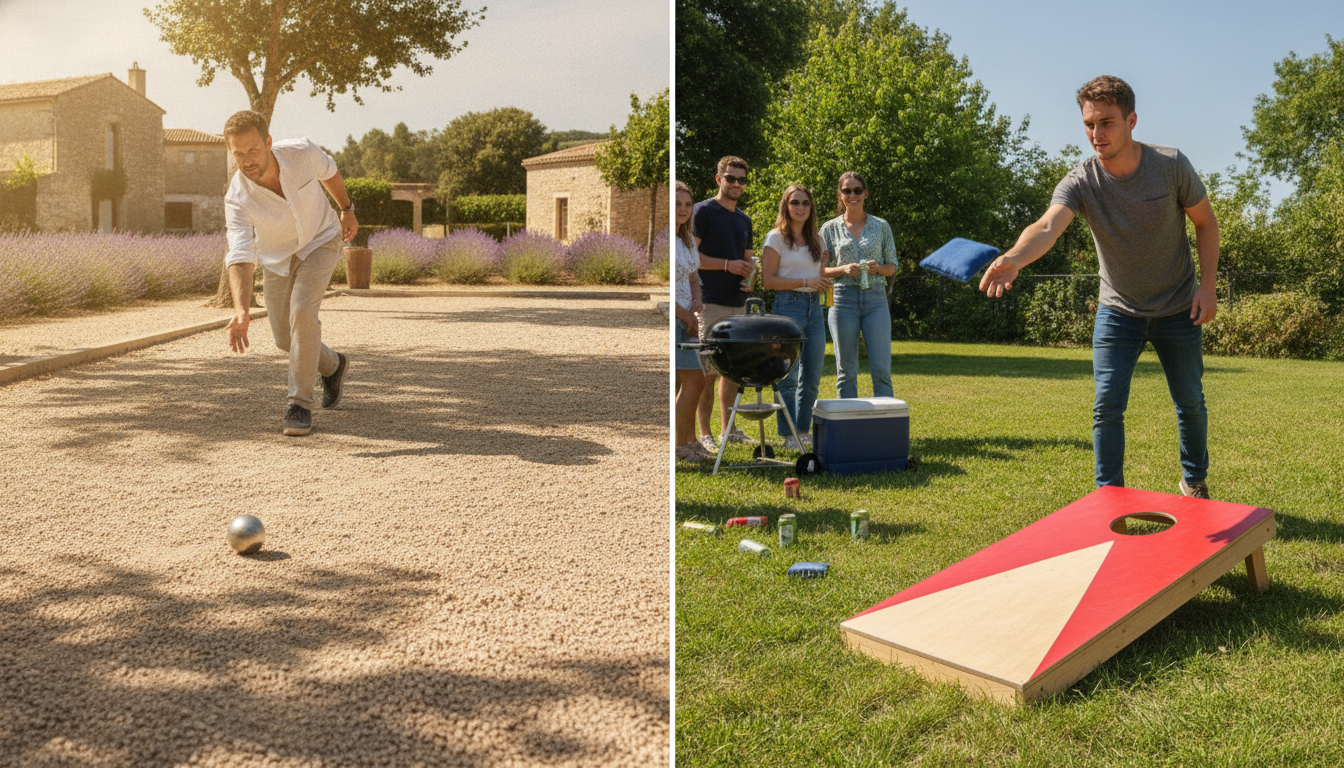
Pétanque vs. Cornhole: The Complete Comparison Guide
Pétanque and cornhole are both easygoing throwing games perfect for a backyard afternoon, but their equipment, courts and scoring differ sharply. Compare them here.
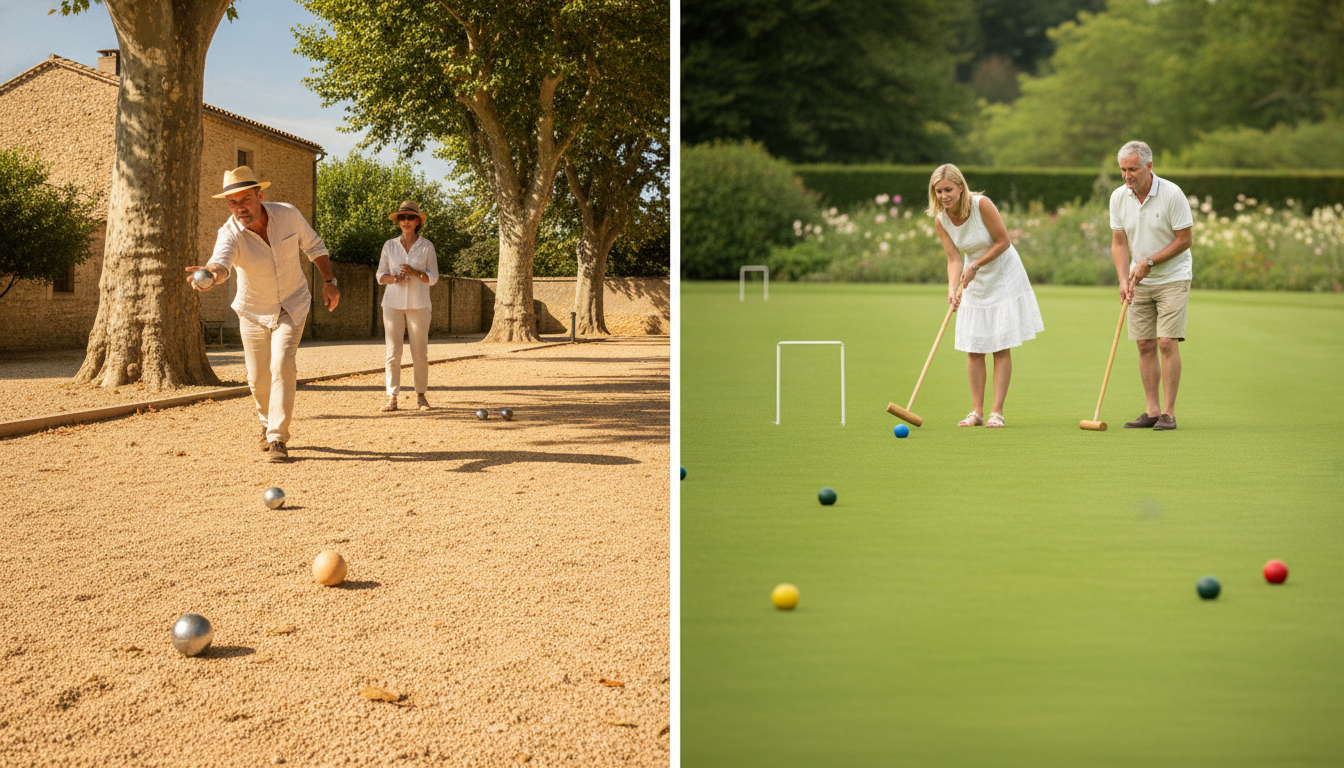
Pétanque vs. Croquet: The Complete Comparison Guide
Pétanque and croquet are both precision lawn games with old European roots. Compare origins, equipment, court size, gameplay, and scoring here.
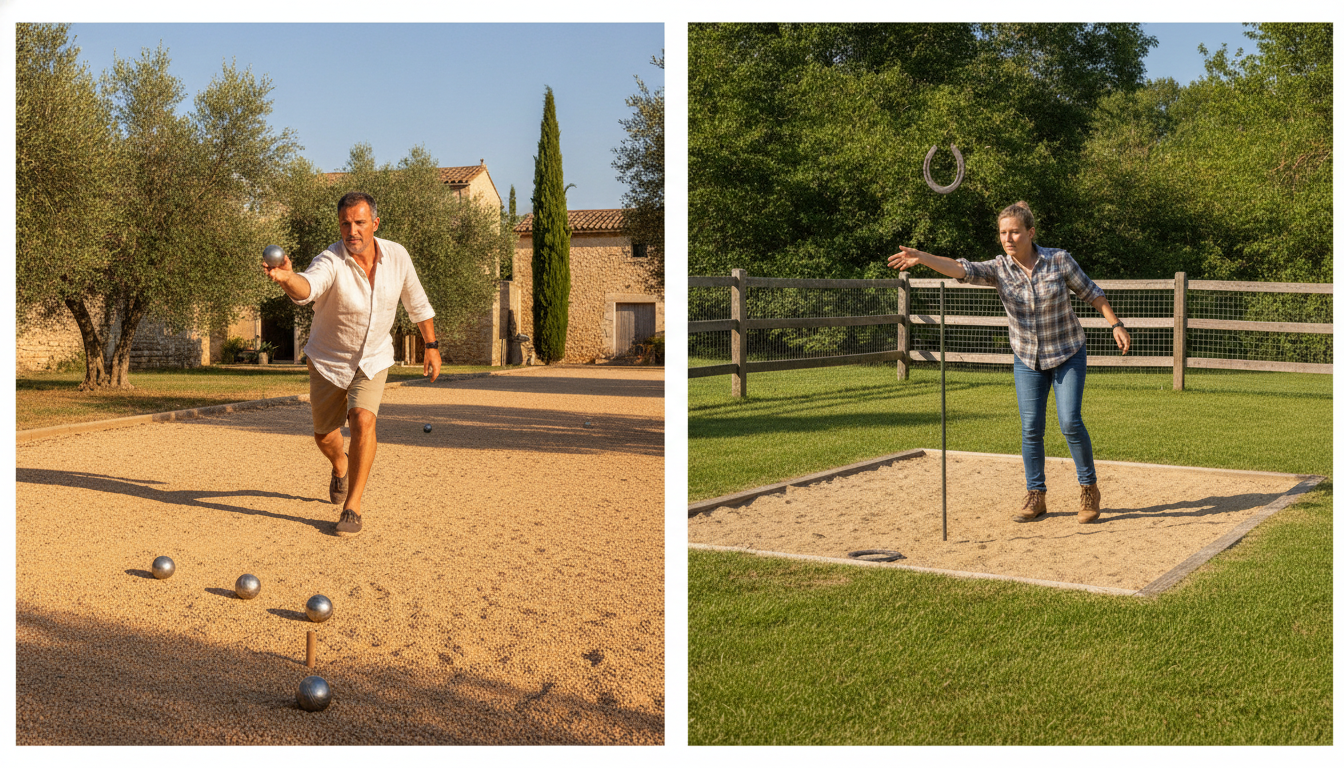
Pétanque vs. Horseshoes: The Complete Comparison Guide
Pétanque and horseshoe pitching are both low-impact target-throwing games loved by all ages. Compare origins, equipment, court setup, and scoring.