
Pétanque vs. Boccia: The Complete Comparison Guide
Pétanque and boccia come from the same boules family and share a 'closest ball wins' scoring system, but boccia is a classified Paralympic sport played indoors. Compare rules, gear and more.
Pétanque vs. Boccia: The Complete Comparison Guide
The names alone cause plenty of confusion - pétanque, bocce, and boccia are often mixed up, and boccia is genuinely a member of the same boules family as pétanque. Both games score the same way: throw a ball, land it as close as possible to a smaller target ball, and count whichever team has the closest balls at the end of the round. Past that shared DNA, the two games serve very different purposes. Boccia is a formally classified Paralympic sport built around adapting play to a wide range of physical abilities; pétanque is an unclassified outdoor game played the same way by everyone.
This guide compares the two across history, equipment, court, gameplay, scoring, and accessibility, so you know exactly what sets them apart.
Quick Comparison Table
| Feature | Pétanque | Boccia |
|---|---|---|
| Origin | La Ciotat, France (1907) | Adapted from Italian bocce for athletes with cerebral palsy, Sweden (1970s) |
| Governing body | FIPJP (international, since 1958) | Boccia International Sports Federation (BISFed, since 2013) |
| Equipment | Hollow steel boules (70.5-80mm, 650-800g) + wooden jack | Leather balls (275g +/-12g, 270mm +/-8mm circumference), red/blue + white jack |
| Playing surface | Gravel, dirt, sand, lawn - outdoors, no fixed boards | Smooth, flat indoor court, 12.5m x 6m |
| Team size | 1v1, 2v2, or 3v3 (singles, doubles, triples) | Individual, pairs, or teams of three, grouped by classification |
| Core action | Throw or lob a boule toward the jack; can also shoot an opponent's boule away | Throw, roll, kick, or ramp-release a ball toward the jack |
| Physical demand | Low - played standing still in a fixed circle | Varies by classification - from ramp-assisted (no throwing motion required) to overhand throwing |
| Winning format | First to 13 points | Highest cumulative score after a fixed number of ends (4 or 6) |
| Paralympic status | Not a Paralympic or Olympic sport (IOC-recognized since 1986) | Paralympic sport since 1984 |
1. History and Origins
Pétanque: A Century-Old French Adaptation
Pétanque was invented in 1907 in La Ciotat, a coastal town near Marseille. A local merchant, Jules Hugues (nicknamed "Lenoir"), suffered from rheumatism that made the running throw of jeu provençal too painful. His friend Ernest Pitiot, who ran the café attached to the local boulodrome, suggested Hugues play from a fixed position instead, both feet planted inside a circle. The name comes from the Provençal pès tancats ("feet fixed"). The sport has been governed internationally by the FIPJP since 1958, and the IOC formally recognized it in 1986, though it has never been granted full Olympic status - the FIPJP and the World Pétanque and Bowls Federation (WPBF) continue to campaign for Olympic inclusion.
Boccia: Adapted From Bocce for Athletes With Cerebral Palsy
Boccia's name derives from the Latin bottia ("ball"), reflecting its roots in the Italian bocce tradition and the wider boules family that includes pétanque. In the 1970s, the game was adapted in Sweden specifically for athletes with cerebral palsy, giving players with limited motor control a boules-style game they could compete in on equal terms. It made its international competitive debut at the joint 1984 Paralympic Games in New York City and Stoke Mandeville, becoming only the second sport created specifically for the Paralympics. The sport was governed by CP-ISRA (Cerebral Palsy International Sports and Recreation Association) before the Boccia International Sports Federation (BISFed) took over as its independent governing body in 2013. As of 2020, more than 75 national boccia organizations had joined international governing bodies.
2. Equipment: Steel Boules vs. Leather Balls
Both games throw a ball toward a smaller target ball, but the equipment itself has little in common beyond that shape.
Pétanque Boules
Pétanque is played with hollow metal balls, usually steel, held palm-down and thrown or lobbed underhand.
- Diameter: 70.5mm to 80mm
- Weight: 650g to 800g
- Target ball: the cochonnet (jack), a small wooden or synthetic ball about 30mm across
See our guide on how to choose your first boules for buying advice.
Boccia Balls
Boccia uses soft leather balls, panel-stitched from low-stretch materials like vinyl, polyurethane fabric, leather, or suede, deliberately built to grip rather than roll freely.
- Weight: 275g, plus or minus 12g
- Circumference: 270mm, plus or minus 8mm (checked against a BISFed standard template)
- Colors: red or blue, six balls per side per end, plus a white jack ball
- Ramps: BC3-classified athletes who cannot consistently grasp or release a ball use an assistive ramp, aimed and adjusted only by the athlete's own instructions to a Sport Assistant who must face away from the court
3. The Playing Surface
Pétanque's terrain is part of the game's character; boccia's is deliberately standardized so it plays exactly the same everywhere.
Pétanque: Play Almost Anywhere
Pétanque needs no dedicated court - a gravel driveway, a dirt path, a beach, or a park lawn all work. Competitive matches use a marked lane, with the FIPJP specifying 15m x 4m for national and international championships (a 12m x 3m minimum is allowed for other sanctioned competitions). The natural unevenness of the ground is part of the strategy. See our full court dimensions guide for the official specs.
Boccia: A Fixed Indoor Court
Boccia is always played indoors on a smooth, flat court measuring 12.5m by 6m (41ft by 20ft), with roughly 2 meters of clear space around it. The court is divided into marked throwing boxes for each player or team, and its consistency is deliberate: because many athletes rely on precise, repeatable ball placement, an unpredictable surface would undermine the sport's fairness in a way that pétanque's variable outdoor terrain does not.
4. How You Play: Fixed Circle vs. Classification-Based Delivery
Pétanque: Precision Throwing From a Fixed Circle
Players stand with both feet inside a small circle (35-50cm) and throw the boule underhand, typically adding backspin with a wrist flick so it stops quickly where it lands. Players can also aim to knock an opponent's boule away rather than simply landing close to the jack. Our pointing and shooting technique guides cover the two core throwing styles in depth. FIPJP rules already accommodate players with limited mobility, including wheelchair users, within standard open competition - see our guide to pétanque for players with disabilities for the details.
Boccia: Delivery Method Set by Classification
Boccia groups athletes into four sport classes - BC1 through BC4 - based on functional ability, and the permitted way of delivering the ball follows from that classification. BC2 athletes typically throw overhand or underhand with a variety of grips. BC1 and BC3 athletes, who have more severe limitations affecting the arms, legs, and trunk, may throw, kick, or use an assistive ramp; BC3 specifically covers athletes who cannot consistently grasp or release a ball at all. BC4 covers athletes with a different, non-cerebral-palsy disability (such as muscular dystrophy) but similar functional ability to BC2. Unlike pétanque, there is no single "correct" throwing motion - the rules exist to give every classification a genuinely competitive way to play.
5. Scoring
The scoring concept is one of the closest matches between the two sports.
- Pétanque: Games are played to 13 points. After all boules are thrown in a round (a mène), only one team scores: one point for every boule closer to the jack than the opponent's closest boule. See our full scoring guide for the details.
- Boccia: Uses the identical "closest ball" principle - one point per ball nearer the jack than the opponent's closest ball - but instead of racing to a target score, matches run a fixed number of ends: four ends for individual and pairs play, six ends for team play (three-a-side). Whoever has the higher cumulative score after the final end wins.
6. Physical Demands and Accessibility
This is where the two sports diverge most, and it is the core reason boccia exists as a separate sport rather than as a pétanque variant.
Pétanque is played from a stationary circle and remains genuinely competitive for players well into their 80s and 90s, placing almost no demand on speed, jumping, or cardio fitness. It is not a classified para-sport, but FIPJP competition already welcomes wheelchair users and players with limited mobility into the same events as everyone else - see our guide on pétanque for players with disabilities for how that works in practice.
Boccia takes a fundamentally different approach: it is built entirely around a four-class disability classification system (BC1-BC4) administered by BISFed, covering athletes with cerebral palsy and other conditions causing severe locomotor and motor-control impairment, some of whom compete using powered wheelchairs. Its ramp-and-Sport-Assistant system exists specifically so athletes who cannot grasp or release a ball by hand at all can still compete at the highest level - a level of formal, rules-based accessibility pétanque does not have, since pétanque has no equivalent classification system or assistive-device provisions written into its competitive rules.
7. Popularity and Paralympic Growth
Boccia has been a Paralympic sport since its 1984 debut, and it is one of only two Paralympic sports - alongside goalball - with no Olympic equivalent at all. By 2020, more than 75 national federations had joined international boccia bodies, and coverage of the Paris 2024 Paralympics described it as one of the fastest-growing events on the Paralympic program, with roughly 554 internationally ranked players competing worldwide as of 2023. Pétanque's footprint is older and broader but sits outside both the Olympic and Paralympic programs: it is the dominant boules sport in France, with major strongholds across Southeast Asia (notably Thailand, Laos, and Cambodia) and parts of Northern Europe like Sweden. The IOC recognized pétanque in 1986, two years after boccia's Paralympic debut, but pétanque has never achieved full Olympic status - the FIPJP and the World Pétanque and Bowls Federation continue to press its case today.
Which One Are You Looking For?
You're probably thinking of Pétanque if:
- You want a relaxed, low-impact game you can play with any age group, using nothing but a bag of boules and a jack, anywhere outdoors.
- You're comparing it to bocce because of the similar name - see our dedicated Pétanque vs. Bocce Ball guide for that comparison instead.
- You want to know how it accommodates players with disabilities within ordinary club and competition play.
You're probably thinking of Boccia if:
- You're researching a Paralympic sport, its BC1-BC4 classification system, or how the ramp-and-Sport-Assistant setup works.
- You're looking for an indoor game a group with a wide range of physical abilities can all play competitively on equal terms.
- You encountered it through the Paralympics and want to understand how it relates to the outdoor game pétanque.
Frequently Asked Questions
Is pétanque the same as boccia?
No, though they are close relatives in the boules family and share the same "closest ball wins" scoring. Boccia is a classified Paralympic sport played indoors with adaptive rules, including a ramp option, while pétanque is an unclassified outdoor game played the same way by everyone.
What is the main difference between pétanque and boccia?
Boccia is built around a formal disability classification system (BC1-BC4) with adapted delivery methods, including assistive ramps. Pétanque has no classification system, though FIPJP rules already welcome wheelchair users and players with limited mobility into standard competition.
Is boccia only for players with disabilities?
At the classified, competitive level, yes - Paralympic and BISFed-sanctioned boccia is for athletes with cerebral palsy or another disability affecting motor control. Recreational, unclassified boccia is played more widely, including in schools.
Do you need a ramp to play boccia?
Only some athletes do. BC3-classified players, who cannot consistently grasp or release a ball, use an assistive ramp directed by a Sport Assistant. Athletes in classes BC1, BC2, and BC4 throw, roll, or kick the ball without one.
Which is older, pétanque or boccia?
Pétanque, by decades. It was invented in 1907 in France. Boccia was adapted from Italian bocce for athletes with cerebral palsy in Sweden in the 1970s and debuted at the 1984 Paralympic Games.
Ready to get started?
- Check out our Beginner's Guide to Pétanque
- Browse the best pétanque sets for backyard and garden play
- Learn the official pétanque scoring rules
- Curious how pétanque already accommodates players with disabilities? See our guide to pétanque for players with disabilities
- Curious how pétanque compares to other backyard games? See Pétanque vs. Pickleball, Pétanque vs. Cornhole, Pétanque vs. Bocce Ball, and Pétanque vs. Lawn Bowls
- Curious how it compares to horseshoes, one of the closest games to pétanque in spirit? See Pétanque vs. Horseshoes
- Curious how it compares to kubb, a Swedish block-throwing game especially popular alongside pétanque in Sweden? See Pétanque vs. Kubb
- Curious how it compares to croquet, a mallet-and-hoop game that may share French royal-court roots with pétanque? See Pétanque vs. Croquet
- Curious how it compares to Spikeball, a fast, athletic net game with no boules involved at all? See Pétanque vs. Spikeball
- Curious how it compares to curling, a winter sport that swaps pétanque's fixed circle for a sliding stone steered by sweeping brooms on ice? See Pétanque vs. Curling
- Curious how it compares to a court game where a disc is pushed with a cue instead of a ball thrown by hand? See Pétanque vs. Shuffleboard
- Curious how it compares to darts, a stationary precision game thrown overhand at a fixed board indoors instead of underhand at a moving jack outdoors? See Pétanque vs. Darts
- Curious how it compares to bowling, an indoor game where the goal is to knock down ten pins rather than land closest to a target? See Pétanque vs. Bowling
- Curious how it compares to Mölkky, Finland's own numbered-skittle throwing game invented in 1996? See Pétanque vs. Mölkky
Related Articles
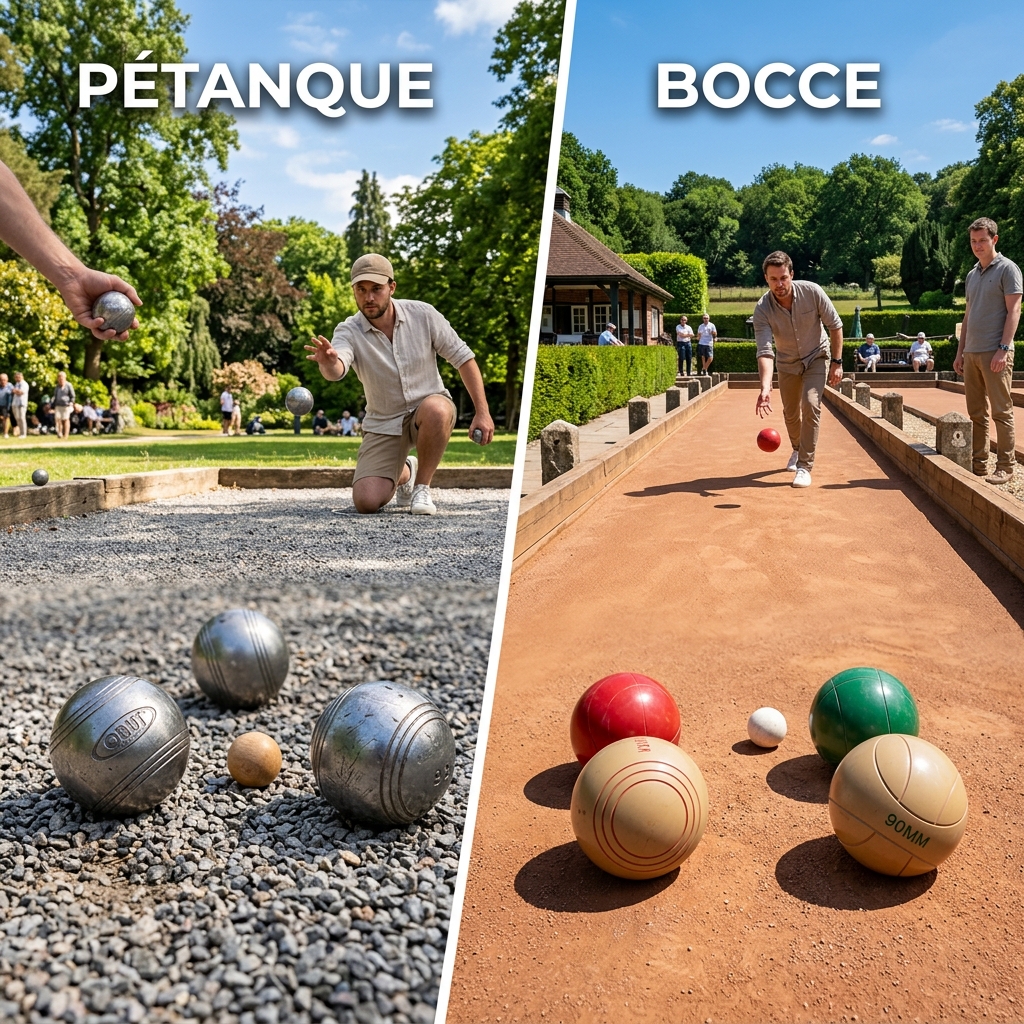
Pétanque vs. Bocce Ball: The Ultimate Comparison Guide
Confused between pétanque and bocce? Discover the key differences in rules, equipment, court dimensions, and throwing techniques in this definitive guide.
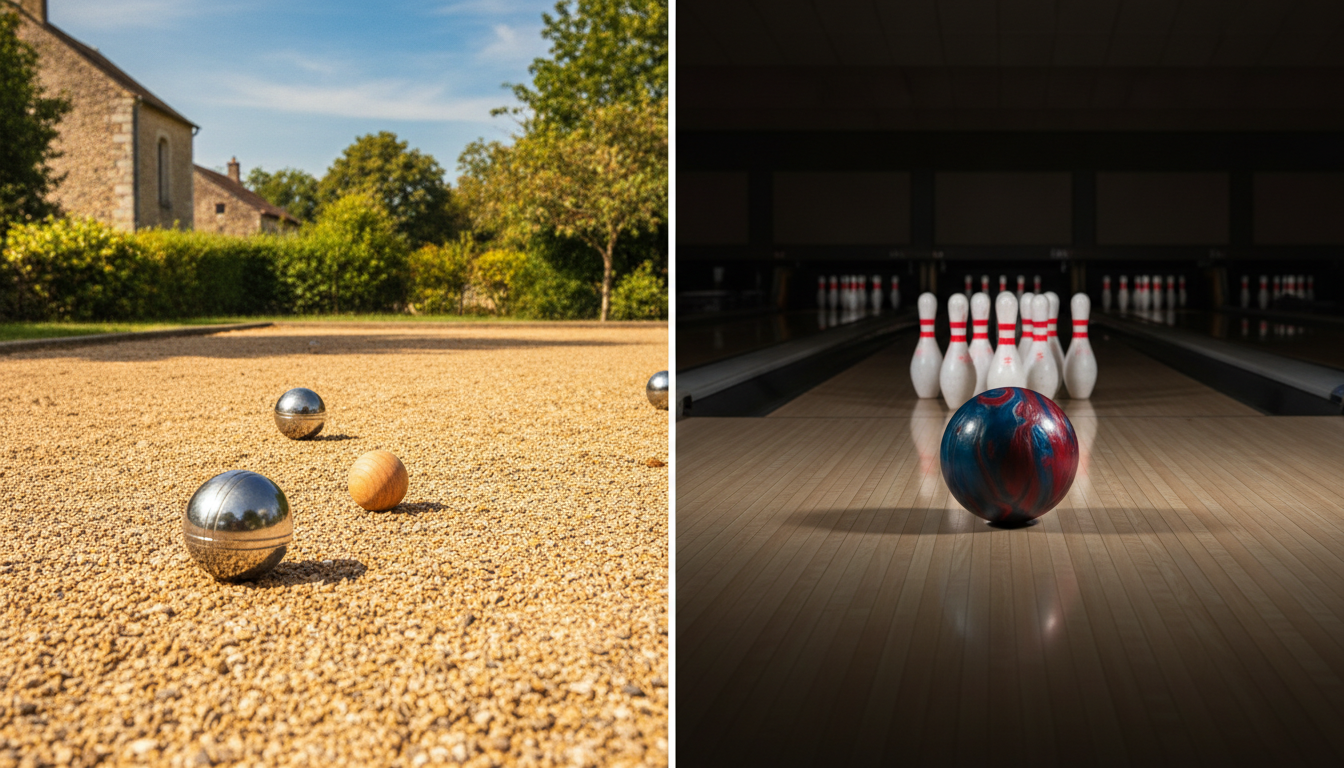
Pétanque vs. Bowling: The Complete Comparison Guide
Pétanque and ten-pin bowling are both precision games about landing closest to (or knocking down) a target, but one is played on outdoor gravel and the other on an indoor lacquered lane. Compare history, gear, and rules.
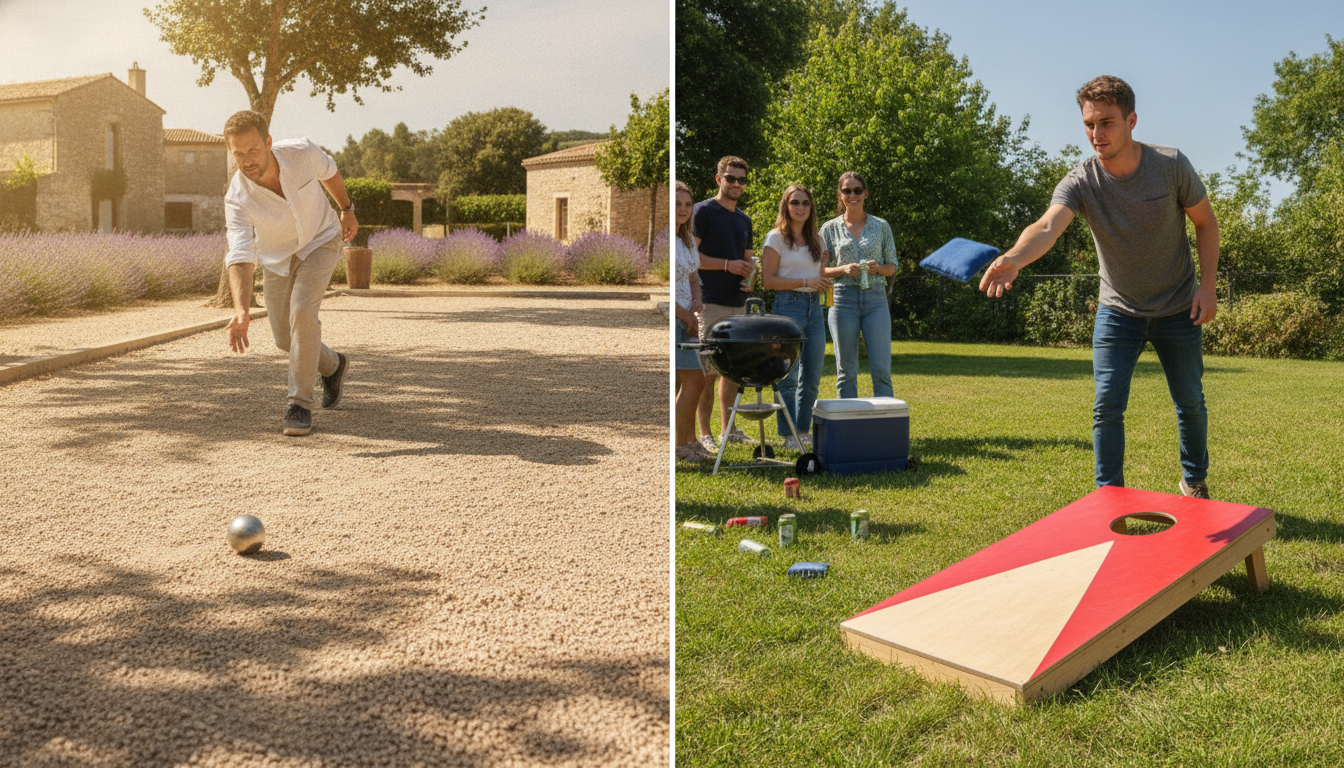
Pétanque vs. Cornhole: The Complete Comparison Guide
Pétanque and cornhole are both easygoing throwing games perfect for a backyard afternoon, but their equipment, courts and scoring differ sharply. Compare them here.